Place Value Chart: Order Big Numbers Greatest to Least (Grade 4, Core) | Math Aha! Theater #08
Short answer
- Greatest to least: 1 million 20 thousand > 1 million 500 > 999 thousand 900.
- 999 thousand 900 has no digit in the millions place. It is 100 less than 1 million.
- 1 million 20 thousand and 1 million 500 first differ in the ten thousands place: 2 and 0.
Also calledcompare big numbersorder numbers greatest to leastplace value chart millionscomparing multi-digit numbers4.NBT.A.2
Video

Pressing play loads the YouTube player on this page. Watch on YouTube
Try it
Explained
In the video
- 0:00The three numbers to put in order
- 0:30Can we tell by looking?
- 1:14Building a place-value chart
- 1:47Writing the first number in the chart
- 2:07Comparing all three in the chart
- 3:05Do all those nines count?
- 4:07How to compare big numbers
- 4:43Practice 1
- 5:34Practice 2
- 6:26Try one on your own
- 7:12Checking the answer
- 7:49Today's key idea
Math Aha! Theater | Grade 4 · Core | Numbers & calculation | For parents and teachers
One number has four nines in a row. Two others have a million in them. Which is greatest? This page collects the problems from the video and one dependable way to compare and order big numbers: line them up in one place-value chart and compare from the left. The video works through these problems in order.
This page includes the answers. If you are working with a child, show only "The problems" first, and give them time to think before you open the sections marked as containing answers.
The problems
The main problem
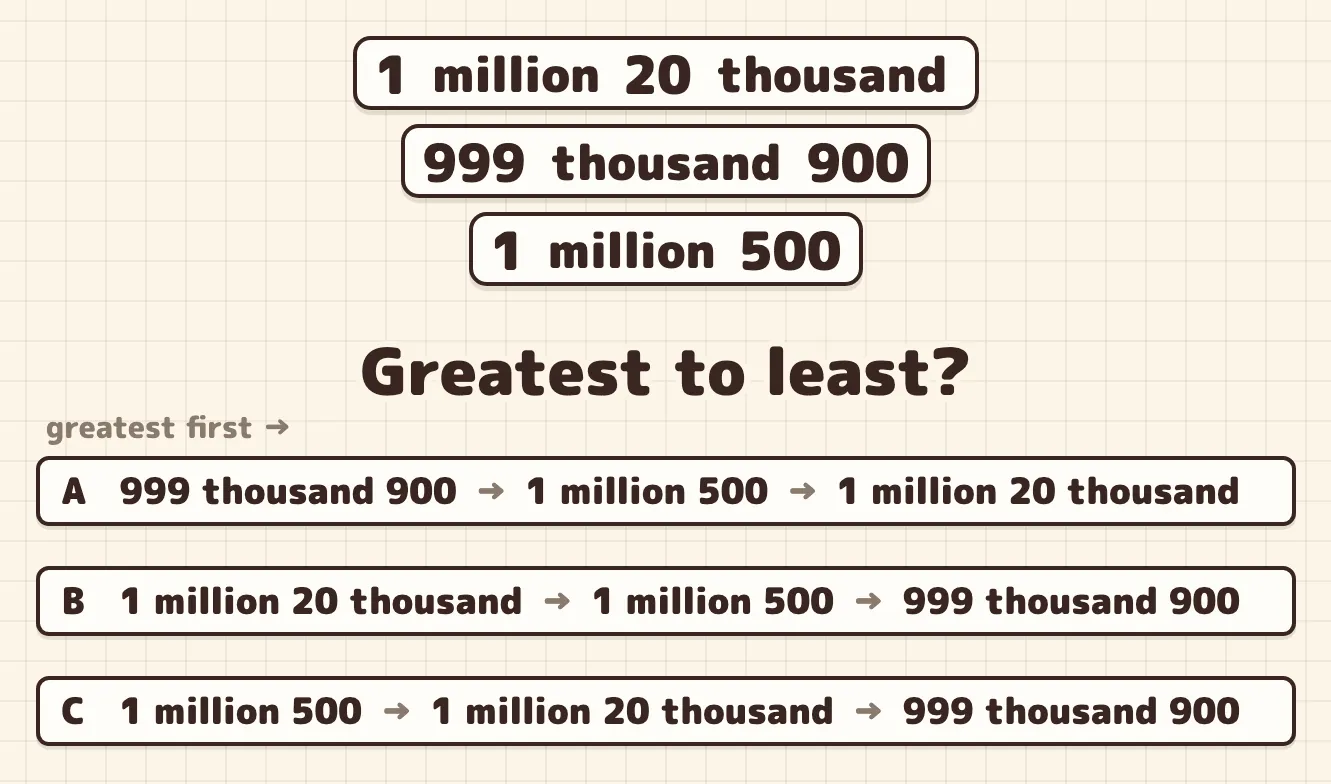
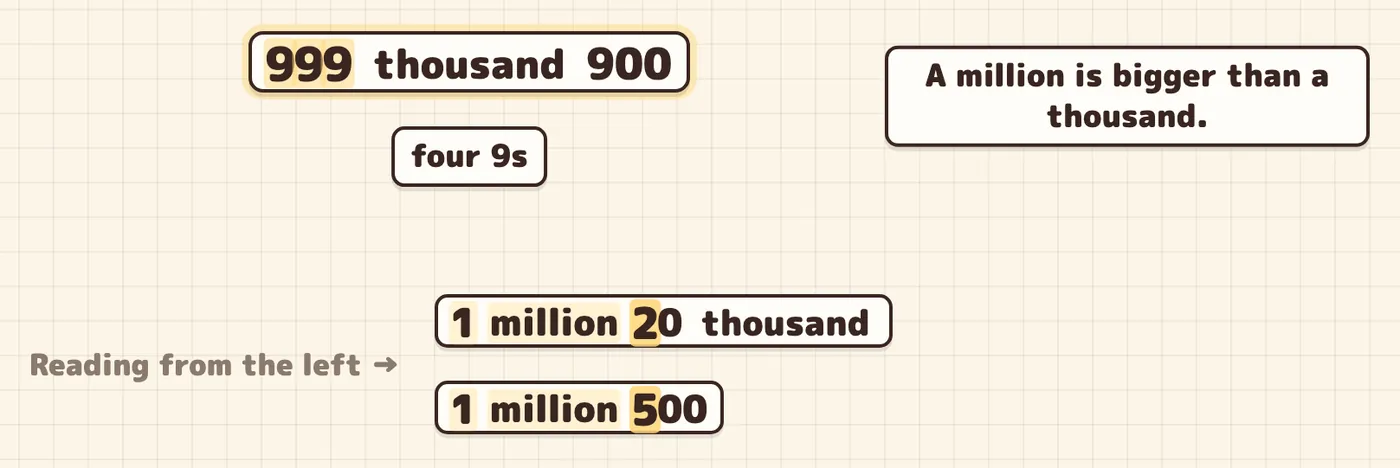
Put these three numbers in order, from greatest to least: 1 million 20 thousand, 999 thousand 900, and 1 million 500. Which order is right?
- A: 999 thousand 900 → 1 million 500 → 1 million 20 thousand
- B: 1 million 20 thousand → 1 million 500 → 999 thousand 900
- C: 1 million 500 → 1 million 20 thousand → 999 thousand 900
Practice problems
Practice 1: Which is greater, 3 million or 2,999 thousand?
Practice 2: Which is greater, 1 million 10 thousand or 1 million 100?
On your own
Which is greater, 2 million 50 thousand or 1 million 900 thousand?
Pause and think before you open the answers.
What children usually try first
Both wrong guesses come from sensible ways of looking. It helps to say "you were noticing something real" before moving to the chart.
Looking only at the digits
If a child ignores "million" and "thousand" and compares the last group of digits (900, 500, 20), they get guess A. It feels natural: the 900 is the biggest-looking part.
Reading from the left without lining up places
A child who knows a million is bigger than a thousand may still read the two million-numbers digit by digit from the left. After "1 million" comes a 2 in one and a 5 in the other, and 5 looks bigger. That gives guess C.
Writing it all in digits and counting zeros
This is a correct method. But one million already has six zeros in a row, and counting zeros is easy to get wrong as numbers grow.
So the first move is: put numbers with units like million and thousand into one chart, lined up place by place, before comparing.
Comparing with a place-value chart
Drawing the chart
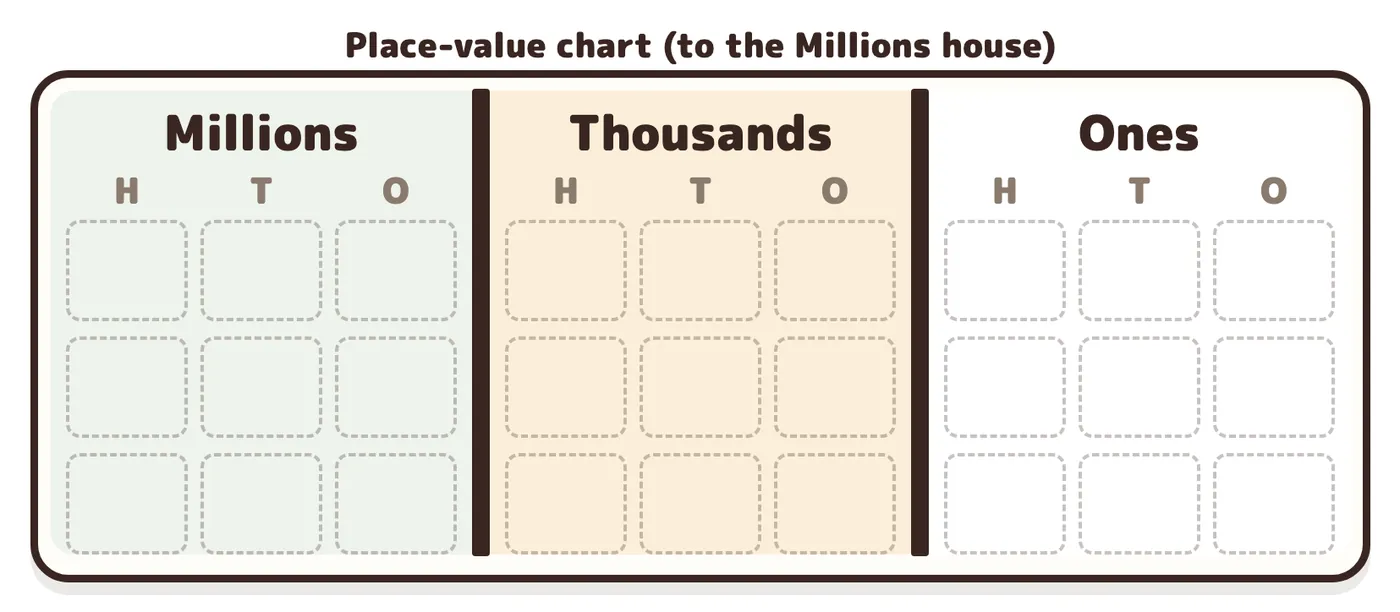
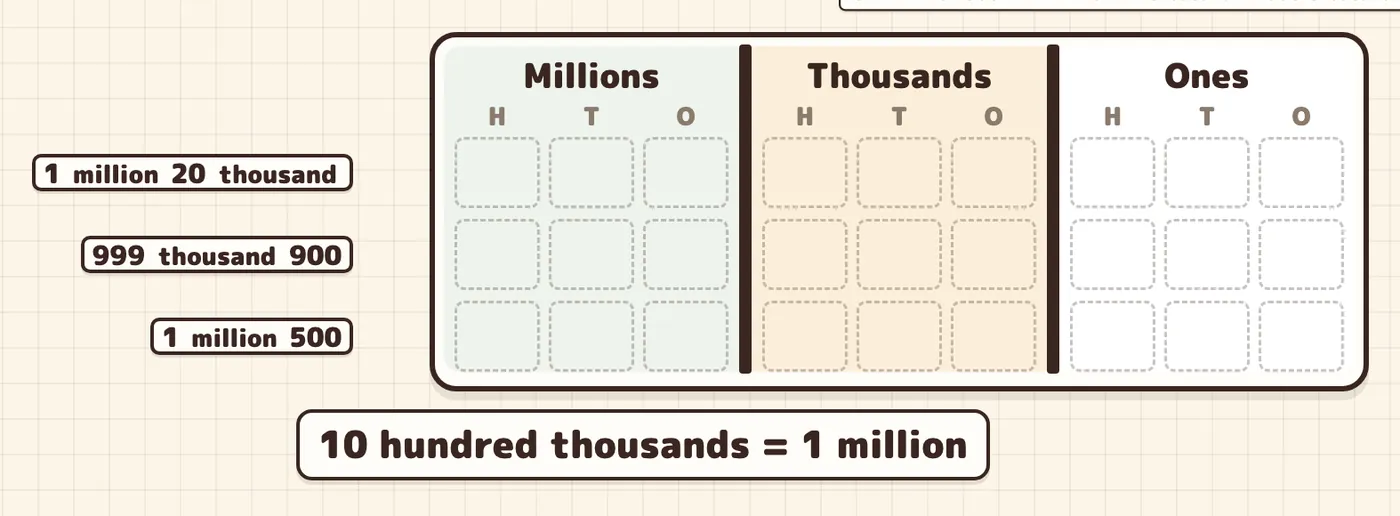
Draw place boxes in groups of three from the right, separated by thick lines ("walls"). From the right, the groups are the Ones house, the Thousands house, and the Millions house; each has hundreds, tens, and ones. (Each house of three places is also called a period.) The walls sit exactly where the commas go when you write the number in digits.
Putting each part in its house
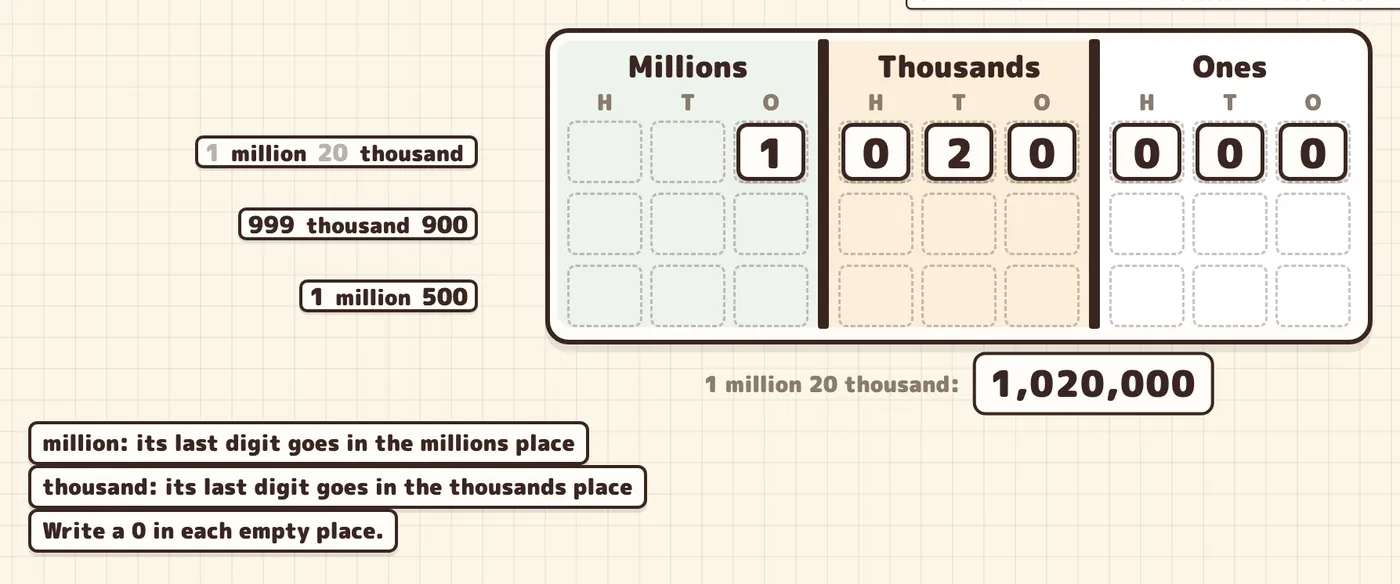
Put the number in front of "million" so its last digit is in the millions place, and the number in front of "thousand" so its last digit is in the thousands place. For 1 million 20 thousand, the 1 goes in the millions place, and 20 lines up its right end with the thousands place, so the 2 lands in the ten thousands place. If a part has more digits than its house has places, the extra digits spill over the wall into the next house to the left.
Filling in the zeros
Write a 0 in every empty place to the right of the first digit. Reading 1 million 20 thousand across the row gives 1,020,000, which matches the number we started with.
Comparing from the left
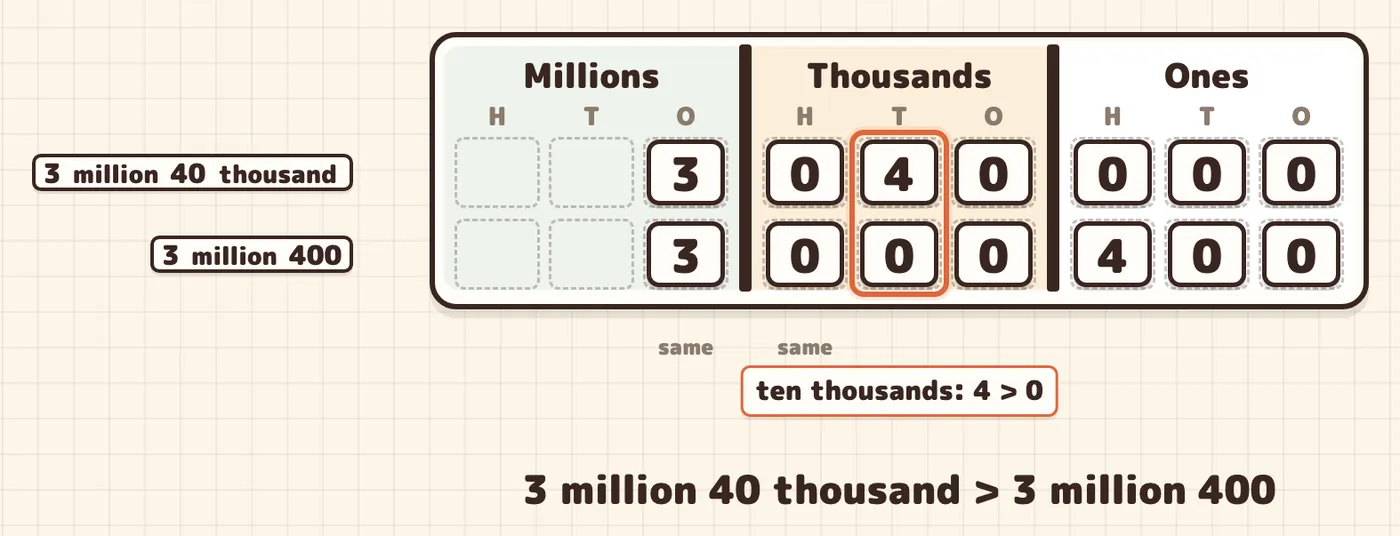
Put each number in its own row, the same way. Start at the leftmost place where any row has a digit and move right one place at a time. An empty place counts as 0. At the first place where the digits differ, the greater digit wins, and you can stop.
Example: 3 million 40 thousand and 3 million 400. The millions and hundred thousands places match; in the ten thousands place it's 4 and 0, so 3 million 40 thousand is greater.
This is exactly the skill in Common Core 4.NBT.A.2: compare two multi-digit numbers "based on meanings of the digits in each place."
Ordering three or more numbers
At the place where the digits differ, split the rows into a "greater" group and a "lesser" group, then keep comparing only the rows that still match. If you slide the greater rows up and the lesser rows down as you go, the chart ends up in order from greatest to least.
Why the place on the left decides
Add 100 to 999 thousand 900. The 9 in the hundreds place becomes 0 and a 1 moves left; the thousands, ten thousands, and hundred thousands turn from 9 to 0 one after another, and the 1 jumps over the walls into the millions place. So 999 thousand 900 + 100 = 1 million. Even 999 thousand 999, with every place a nine, becomes exactly 1 million when you add 1.
In every place, one unit is exactly 1 more than all nines to its right. A 1 on the left beats all the nines to its right, which is why the first place where the digits differ decides the comparison. It is the same idea as Common Core 4.NBT.A.1: each place is worth ten times the place to its right.
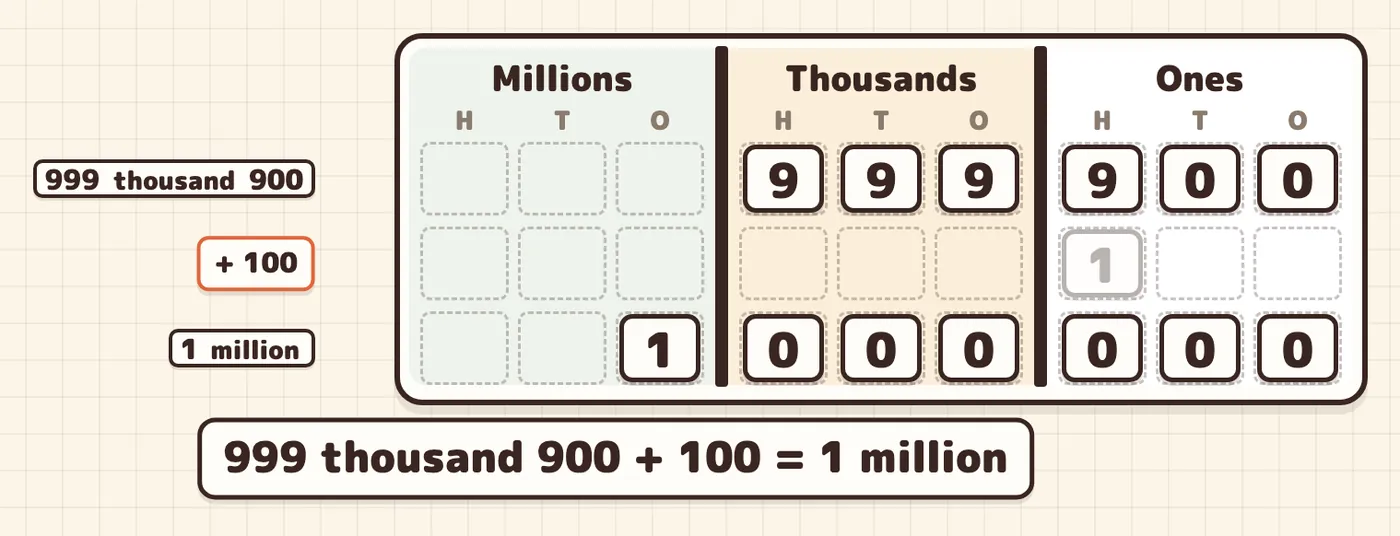
See it move: the nines turn to zeros one by one and the 1 lands in the millions place (about 8 seconds)
Answers and checks (contains answers)
The main problem
1 million 20 thousand > 1 million 500 > 999 thousand 900 (guess B). In the chart, only 999 thousand 900 has no digit in the millions place, so it is the least. The other two match in the hundred thousands place, and in the ten thousands place it's 2 and 0, so 1 million 20 thousand is greater.
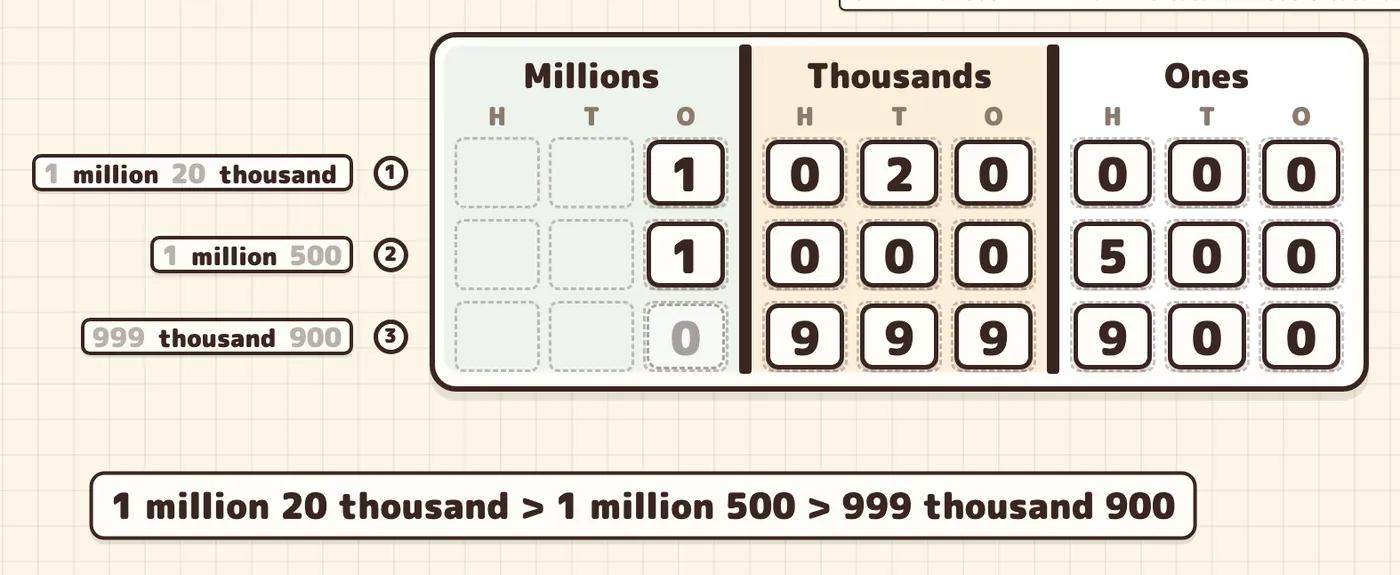
See it move: the frame moves from the left and the rows slide into order (about 11 seconds, sped up from the video)
In digits, the numbers are 1,020,000, 1,000,500, and 999,900: seven, seven, and six digits. Same order.
Practice 1 and Practice 2
Practice 1: 3 million > 2,999 thousand. The four digits of 2,999 don't fit in the Thousands house, so the 2 spills into the millions place: 2,999 thousand is 2 million 999 thousand. In the millions place it's 3 and 2. (Add 1 thousand and it would be exactly 3 million.)
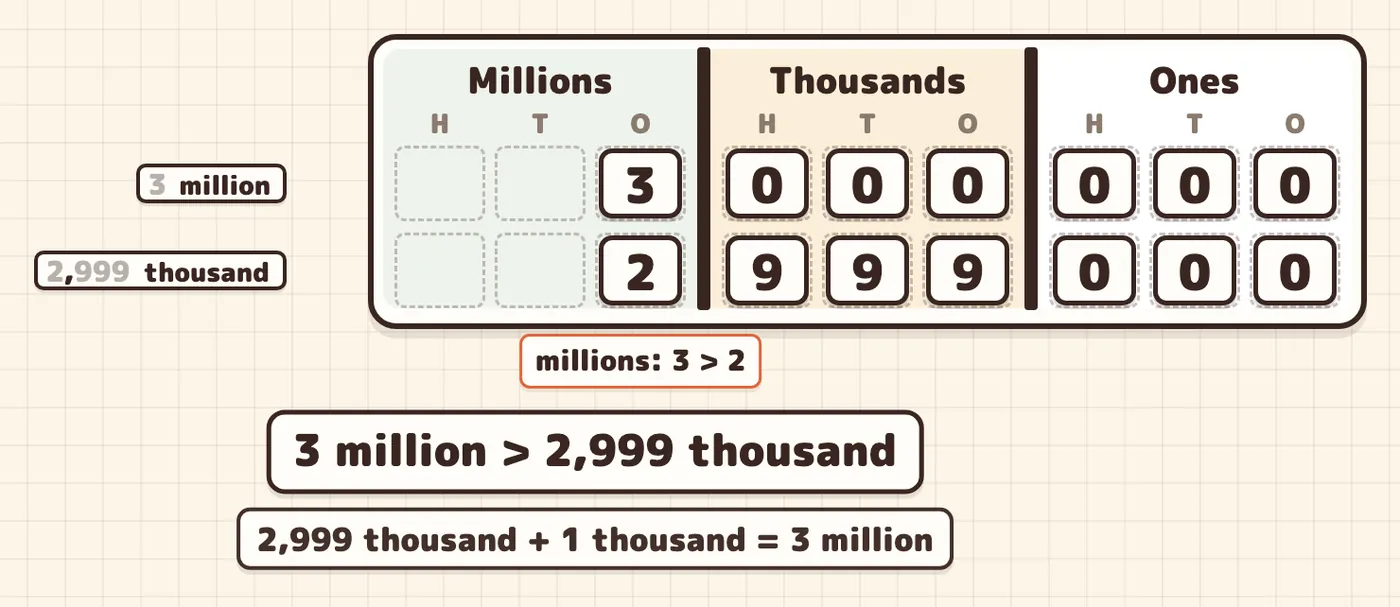
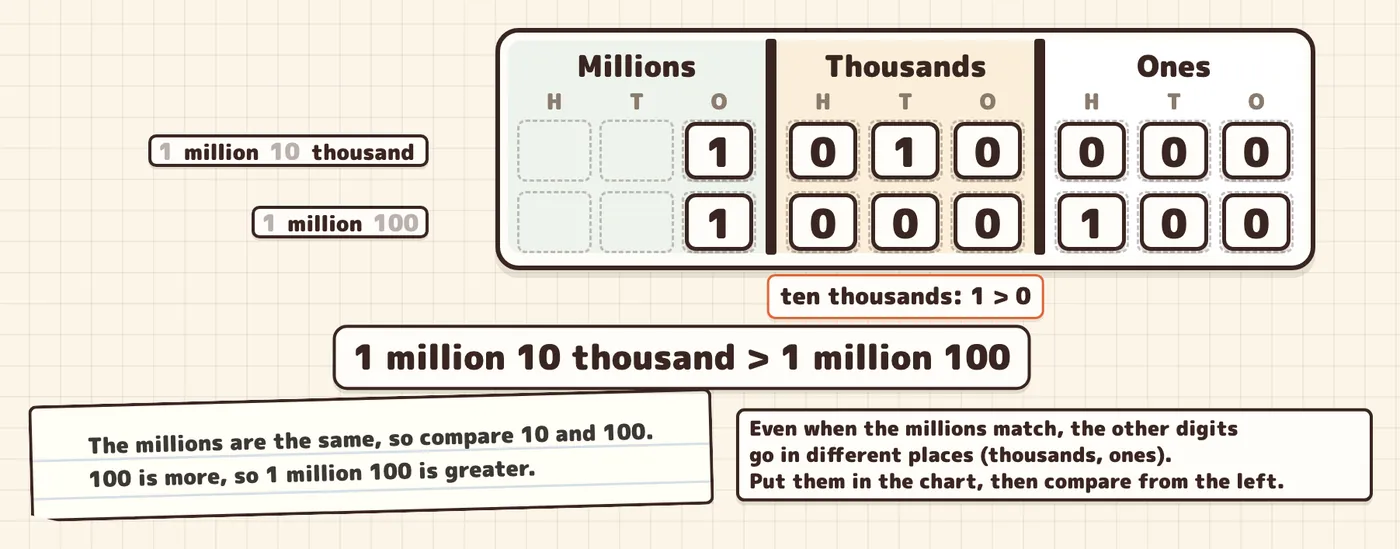
Practice 2: 1 million 10 thousand > 1 million 100. The 1 in 10 thousand is in the ten thousands place; the 1 in 100 is in the hundreds place. In the ten thousands place it's 1 and 0.
On your own
2 million 50 thousand > 1 million 900 thousand. In the millions place it's 2 and 1. The 900 may look bigger than 50, but the place on the left decides.
How to check: put a round number in between
Put exactly 2 million between the two numbers. 1 million 900 thousand + 100 thousand = 2 million, so 1 million 900 thousand is less than 2 million. 2 million 50 thousand is 2 million plus 50 thousand, so it is more than 2 million. On a number line marked every 10,000, they sit 10 marks to the left and 5 marks to the right of 2 million.

Common slips and how to fix them
Every slip below can be fixed by the child: put both numbers in the chart and compare from the left.
Comparing digits without looking at the units
"4 million or 3,999 thousand? 3,999 is more than 4." In the chart, the 3 spills into the millions place: 3,999 thousand is 3 million 999 thousand. In the millions place it's 4 and 3, so 4 million is greater.
Same millions, different units
"1 million 30 thousand or 1 million 300? 300 is more than 30." The 3 in 30 thousand is in the ten thousands place, but the 3 in 300 is in the hundreds place. In the ten thousands place it's 3 and 0, so 1 million 30 thousand is greater. Practice 2 in the video is the same kind of slip.
Reading from the left without lining up places
"2 million 7 thousand or 2 million 60 thousand? After 2 million it's 7 and 6, and 7 is more." The 6 in 60 thousand is in the ten thousands place; the 7 in 7 thousand is in the thousands place. In the ten thousands place it's 6 and 0, so 2 million 60 thousand is greater.
When a part has too many digits for its house
The Thousands house has only three places, so a number like 2,999 thousand doesn't fit. Line up its right end with the thousands place and let the extra digit cross the wall: 2 million 999 thousand. Then compare.
Another view: the number line
On a number line marked every 100, centered on 1 million, 999 thousand 900 is 1 mark to the left, 1 million 500 is 5 marks to the right, and 1 million 20 thousand is 200 marks to the right, far off the edge. Zoom out to one mark per 10,000 and the first two almost sit on top of 1 million, while 1 million 20 thousand is 2 marks to the right.

See it move: zooming out until one mark is 10,000 (about 9 seconds)
More to try
- A report shows a table labeled "(in thousands)," and one entry reads 2,999. What number does it really stand for? Write it with millions and thousands.
- Put 5 million 8 thousand, 5 million 70 thousand, and 4,999 thousand in order from greatest to least.
- 999 thousand 999 is the greatest whole number with no millions. What do you get when you add 1?
Answers to More to try (contains answers)
- 2,999 thousand, which is 2 million 999 thousand. "(In thousands)" means every entry is that many thousands, so put the 2,999 in the Thousands house, lined up at the thousands place; the 2 spills into the millions place.
- 5 million 70 thousand > 5 million 8 thousand > 4,999 thousand. 4,999 thousand is 4 million 999 thousand, so it has only a 4 in the millions place. The 7 in 70 thousand is in the ten thousands place; the 8 in 8 thousand is in the thousands place.
- Exactly 1 million: every nine turns to zero and a 1 lands in the millions place.
For parents and teachers
- Rather than telling children "don't go by how big the digits look," let them discover it by putting the numbers in a chart.
- Even when the answer is right, ask, "Which place decided it?"
- When the answer is wrong, there's no need to correct the reasoning first. Put that number in the chart and look from the left together.
- Big numbers in the news (populations, budgets, distances) make good material for a quick "which is greater?" game: write two of them in the chart and compare from the left.
Frequently asked questions
Can my child write the order with ">"?
Yes. Chain the numbers with ">": 1 million 20 thousand > 1 million 500 > 999 thousand 900.
Is it wrong to write the numbers in digits and count zeros?
No, it's a correct method. But zeros are easy to miscount. In the chart, places line up without counting.
Is "from the greatest place" the same as "from the left"?
Yes. In a number written with digits, greater places are always further left. The video says "from the left" because that's what children can see on the chart.
What if my child hasn't worked with millions yet?
If they know that ten hundred thousands make one million, the chart works: the Millions house has the same hundreds, tens, and ones as the other houses. The video builds the Millions house from scratch.
How do I draw a place-value chart on paper?
Draw vertical lines to make groups of three boxes from the right. Label the groups Ones, Thousands, Millions from the right, and write H, T, O over the boxes in each group. Make one row for each number you compare.
Try it in the "Number Line-Up" activity
In the hands-on activity at the top of this episode's page, children tap each part of a number into the chart themselves, write the zeros, and press "Compare from the left" to watch the rows slide into order. There are six tasks (including explaining why and fixing a notebook's slips), plus "One more," "Make a puzzle," and a learning map. Time and scores are never recorded.
Sources
Where the facts and numbers in the video and on this page come from.
References
- Problems: all problems on this page are original problems by Tamelabo. Pictures and animations by Tamelabo (font: M PLUS Rounded 1c, SIL OFL 1.1).
Links
- Texas Essential Knowledge and Skills for Mathematics, Subchapter A, Elementary (§111.6, Grade 4) (4.2(C), "compare and order whole numbers to 1,000,000,000 and represent comparisons using the symbols >, <, or =.")tea.texas.gov/sites/default/files/ch111a.pdf
- Common Core State Standards for Mathematics, Grade 4, Number & Operations in Base Ten (4.NBT.A.2, "Compare two multi-digit numbers based on meanings of the digits in each place, using >, =, and < symbols to record the results of comparisons," and 4.NBT.A.1 (each place is ten times the place to its right). Common Core notes that "Grade 4 expectations in this domain are limited to whole numbers less than or equal to 1,000,000"; this episode goes a little beyond that (up to 3 million))thecorestandards.org/Math/Content/4/NBT
Voice, music, art
- Voice: Kokoro (synthetic voice) / Music (OpenTracks): “のんびり行こうよ” by zmino, “パステルハウス” by かずち / Sound effects: Tamelabo (made with code) / Font: M PLUS Rounded 1c (SIL OFL 1.1) / Art, problems, and animation: Tamelabo