How Does a Firework Make Its Colors and Shapes? | How It Works Inside #06
Short answer
- Stars expand their arrangement into a bloom about 1,000 times wider; metals and layers control color.
- In this model, the fuse reaches the center about 7½ seconds after launch.
- About 2,000 ft (600 m) away, the boom arrives about 2 seconds after the flash.
Also calledhow fireworks workwhy fireworks change colorinside a firework shell
Video

Pressing play loads the YouTube player on this page. Watch on YouTube
Explained
In the video
- 0:00A huge bloom and a small shell
- 0:22The four main parts of a shell
- 1:10The time fuse and the climb
- 1:50From star arrangement to sky shape
- 2:58Three familiar firework patterns
- 3:22Hearts and viewing direction
- 3:53A prism reveals the light source
- 5:19Layers set the color timetable
- 6:22One shell, all the mechanisms
- 7:09Four things to watch for
Diagrams show a typical Japanese spherical shell; numbers are model calculations based on published sources, with details below.
The whole journey at a glance
- Pellets called stars line the inside of the shell.
- The shell rises, and a time fuse carries fire toward the center. In this example it reaches the top after about 7½ seconds.
- The burst sends the stars outward. Their arrangement becomes a flower roughly 1,000 times wider than the shell.
- Metals produce the colors. Layers within each star set the order of the color changes.
What the diagrams and numbers mean
This is a simplified model of a Japanese spherical display shell, a type known as warimono. It explains the structure rather than reproducing a particular maker's design. Star layers are colored by the light they produce, not the appearance of the material before it burns.
The launch, star paths, heart orientations, spectra, and sound delay are calculations for an illustration, not real fireworks designs. The model's single layer of stars, star size, inward burning rate, and inner-ring sizes are assumptions. A published shell contained 468 stars, but its reported count does not establish that those stars formed a single layer. Actual shells differ by maker and type.
What's inside the shell?
Casing, stars, burst charge, and time fuse
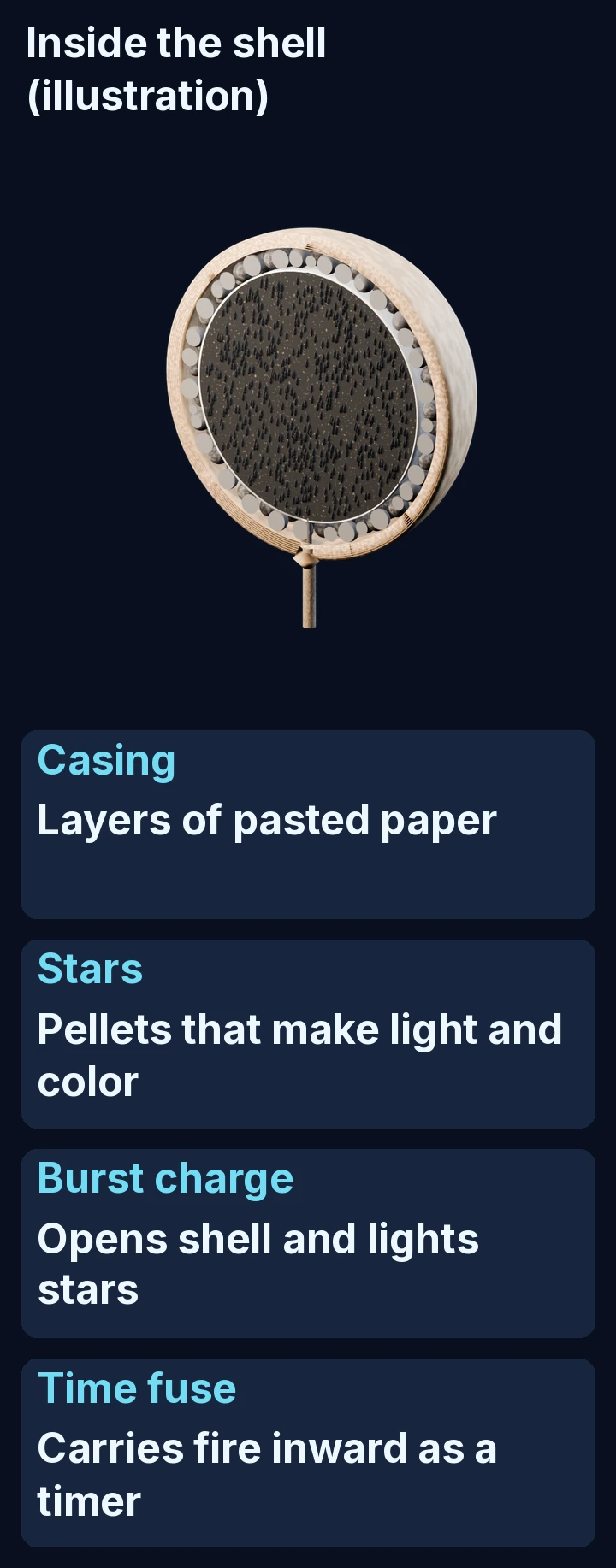
The casing is made from layers of pasted paper. Stars are packed along its curved inner surface. In the middle is the burst charge, which opens the shell and lights the stars. A thin paper partition separates the charge from the stars. The charge is represented here by small husk-shaped grains.
A time fuse carries fire inward from below. A more detailed association diagram also labels material that transfers fire within the shell. We group that into the route leading toward the burst charge. The important distinction is between the charge that launches the shell and the charge that opens it. [Japan Pyrotechnics Association; Honda Kids]
Why 468 stars?
Researchers reported that count for one No. 10 shell in a 1993 experiment. It is a measured example, not a standard count for every shell. The animation keeps track of that many modeled stars so their arrangement and their eventual positions stay connected.
Spheres and cylinders
The Japan Pyrotechnics Association describes traditional Japanese shells as spherical and traditional Western shells as generally cylindrical. A spherical arrangement can appear round from any direction. A cylinder does not distribute stars in the same uniform spherical pattern. This article focuses on the Japanese spherical tradition; it does not claim that every firework worldwide has the same construction.
What is a shakudama?
In Japan, shakudama means a No. 10 shell, launched from a tube about a foot (30 cm) wide. The number refers to the tube's inside diameter. The shell itself is about 11.2 inches (28.5 cm) across in the association's table. The tube width and the shell width are different measurements.
From launch to burst
Two charges with different jobs
The lift charge at the bottom of the tube sends the shell upward. At launch, the time fuse lights too. It carries fire inward until the burst charge ignites. Ideally that happens when the shell reaches the top and its upward speed reaches zero.
The fuse is a timer, not a sensor that detects the highest point. Makers arrange the timing to match the shell's flight. [Honda Kids; Japan Pyrotechnics Association]
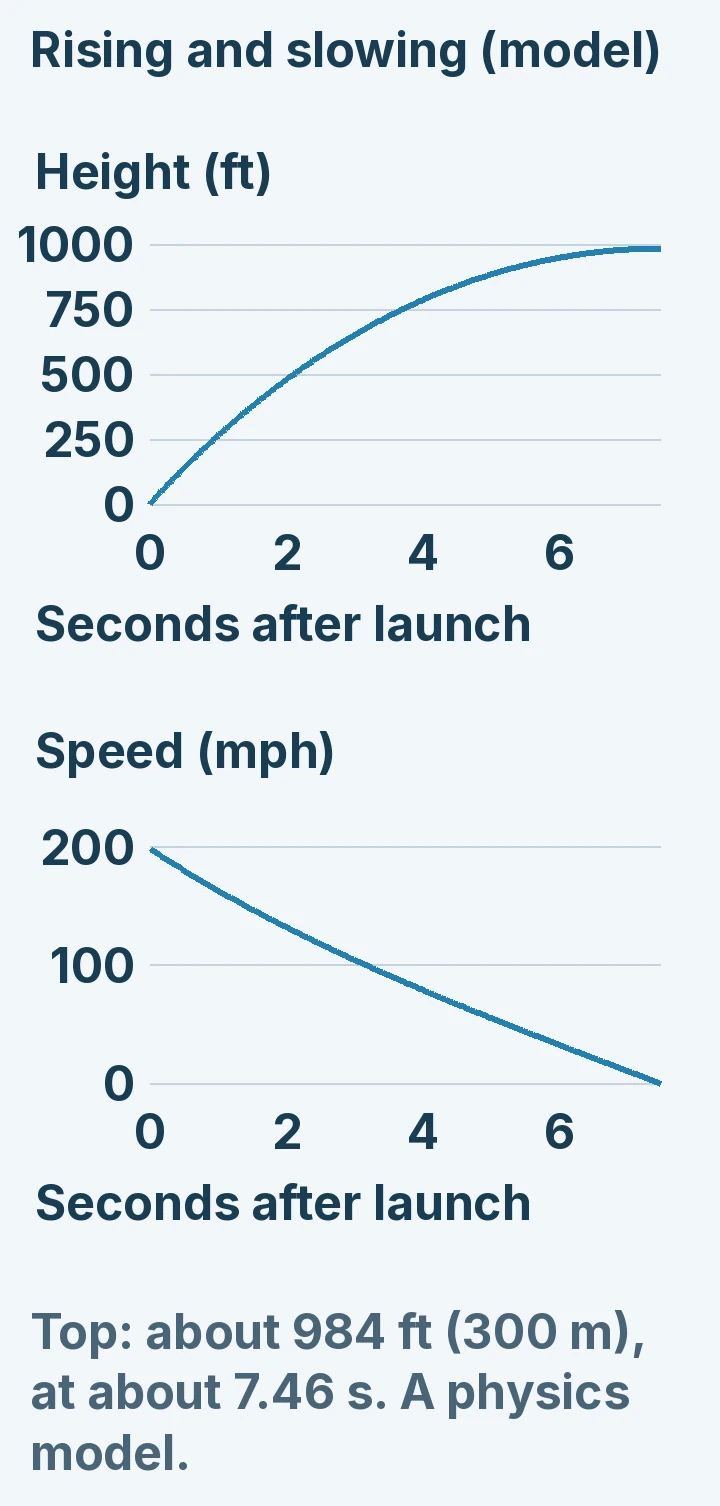
About 7½ seconds to the top
We modeled a shell reaching nearly 1,000 feet (300 m). Using the mass and diameter of a measured shell gives a launch speed of about 200 mph (320 km/h), with a flight time to the top of about 7.46 seconds. Gravity and air drag slow the rise.
The published trajectory study gives drag coefficients for smaller shells, not this No. 10 size. It also reports a tendency for larger shells to have lower coefficients. We therefore used the No. 5 average as the upper end of an illustrative range and chose a lower end informed by the reported distribution. Across that range, the launch estimate is roughly 185–215 mph (300–350 km/h), and the time is about 7.3–7.6 seconds. These are model estimates, not a universal flight specification.
That whistle is an effect
The rising whistle comes from a whistle attached to the shell. It is not simply the noise of air rushing past. Japanese shell names may describe such added effects. [Japan Pyrotechnics Association; Honda Kids]
How the shape forms
An arrangement expanded into the sky
The burst charge pushes the casing apart and lights the stars. If stars placed on a sphere are pushed outward evenly, they move similar distances in every direction. Their arrangement becomes a round bloom. The strength of the pasted casing and the burst work together; uneven paper can make the outward push uneven. [Japan Pyrotechnics Association; Shimizu, 1957]
Air is a powerful brake
Ground-burst measurements found star speeds around 360–425 mph (160–190 m/s), averaging about 176 m/s. The animation starts its modeled stars at 175 m/s. Drag is approximately proportional to speed squared, so the initial high speed produces especially strong braking.
After a second, the modeled flower is about two-thirds of its final width and the stars have slowed below one-third of their initial speed. They do not stop in midair: they keep moving until they burn out. Gravity also lowers the center of the bloom. [Matsunaga and colleagues, 1993; Shimizu, 1957]
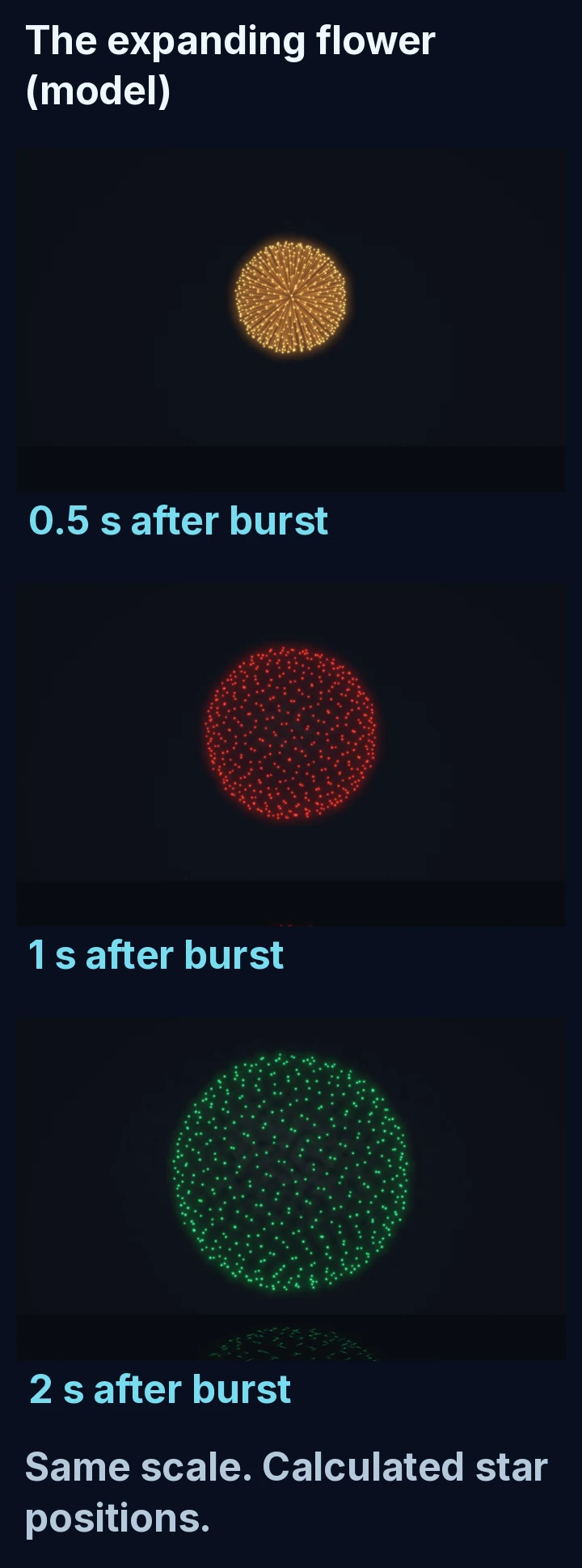
Why roughly a thousandfold?
The association's No. 10 example opens about 920 feet (280 m) across from a shell about 11.2 inches (28.5 cm) wide. Dividing the two diameters gives about 982. That is the basis of “roughly 1,000 times.” It compares widths, not volumes, and the ratio varies with shell size.
| Shell size | Shell diameter | Bloom diameter | Width ratio |
|---|---|---|---|
| No. 3 | 3.4 in (8.6 cm) | 330 ft (100 m) | about 1,160× |
| No. 5 | 5.7 in (14.4 cm) | 490 ft (150 m) | about 1,040× |
| No. 8 | 9.1 in (23.0 cm) | 820 ft (250 m) | about 1,090× |
| No. 10 | 11.2 in (28.5 cm) | 920 ft (280 m) | about 980× |
| No. 20 | 22.8 in (58.0 cm) | 1,480 ft (450 m) | about 780× |
| No. 30 | 33.9 in (86.0 cm) | 1,970 ft (600 m) | about 700× |
| No. 40 | 44.9 in (114 cm) | 2,460 ft (750 m) | about 660× |
Values are approximate, from the association's 2026 guide, with unit conversions and diameter ratios calculated for this article.
Chrysanthemums, peonies, and inner cores
A chrysanthemum has charcoal-orange trails stretching outward from the center. A peony opens with colored points and no such trails. A core is an additional inner arrangement. A Japanese “double-core” shell has two inner cores in addition to the outer flower, making three visible rings. [Japan Pyrotechnics Association; Honda Kids]
Why a heart sometimes looks like a line
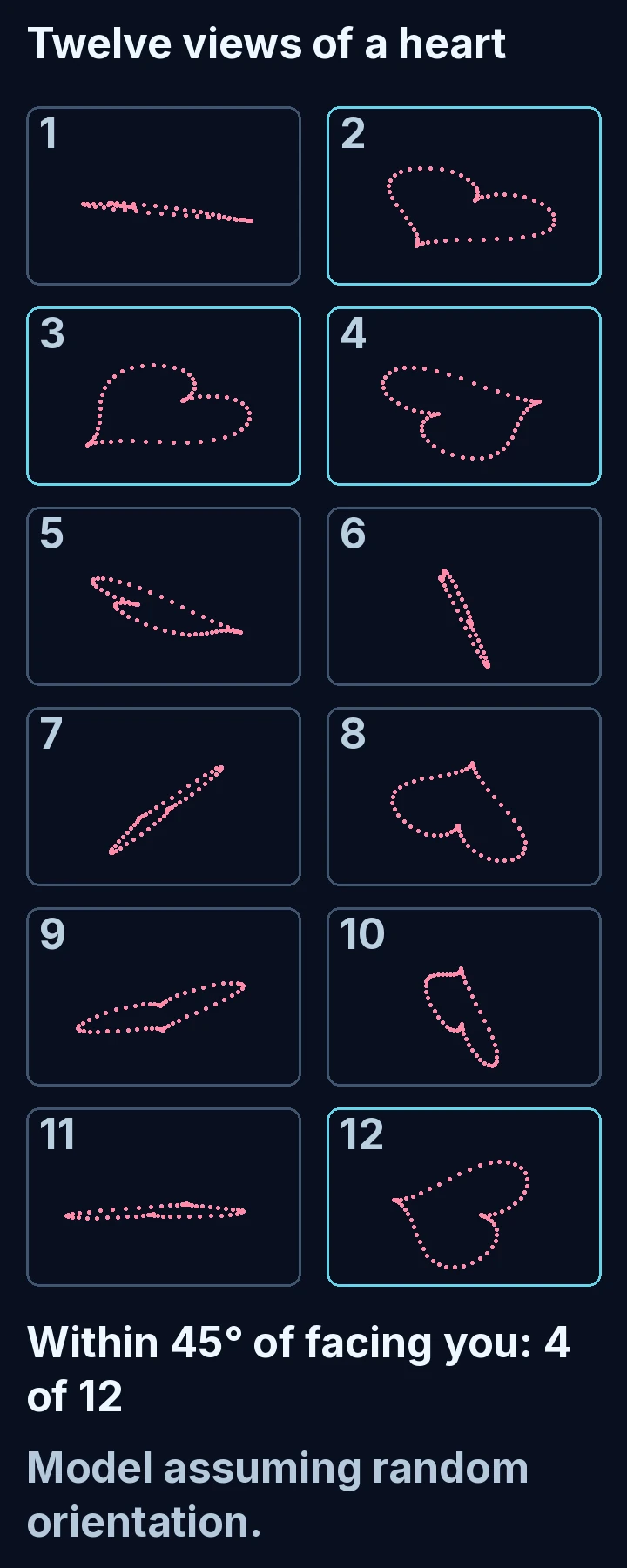
A flat heart pattern is recognizable from the front but becomes thin when viewed edge-on. If its direction were random, and facing the viewer within 45° counted as clear, about 29% would qualify in the model. Four of the twelve illustrated samples qualify. This is a defined viewing test, not a prediction that every show will have the same success rate. Some makers use devices to keep patterns upright. [All About; calculation C8]
Longer-burning stars droop
Stars that keep glowing longer reveal more of their downward motion. This helps explain the hanging appearance of a kamuro, compared with a shorter-lived round chrysanthemum. The burning time matters to the final shape. [Sashimura and colleagues, 2007; calculation C7]
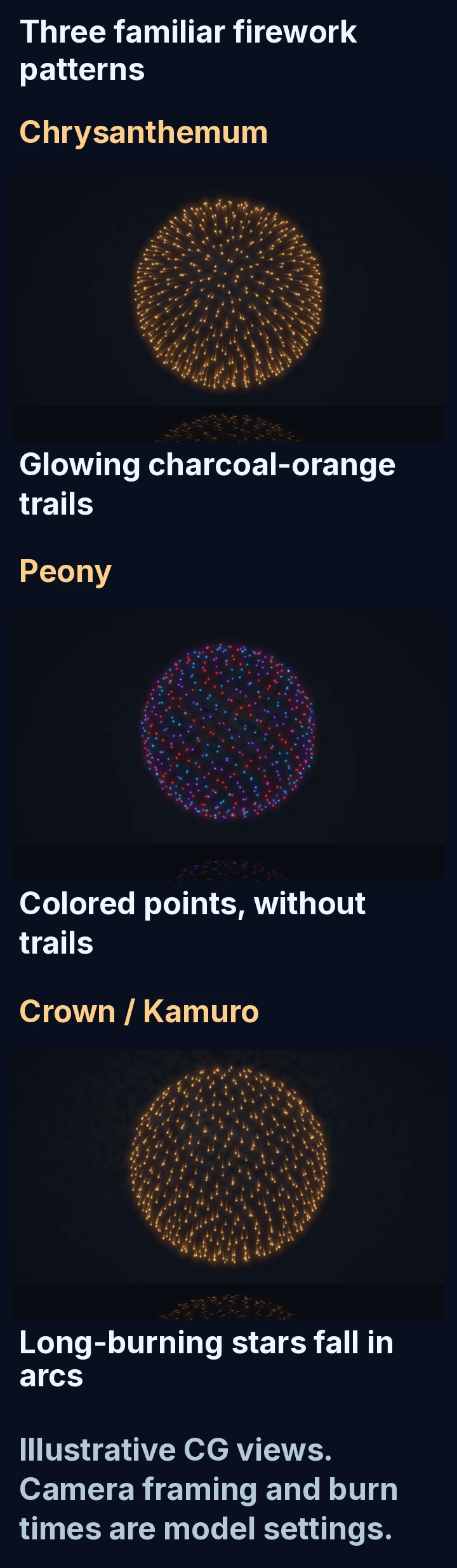
Compare the three patterns in motion
The luminous heads, trails, smoke, and reflections are CG illustrations. Positions follow the inherited trajectory model; the crown uses the longer-burning case from calculation C7. These views do not specify the exact size or burn time of a real firework.
Where the colors come from
Light from heat and light from metals
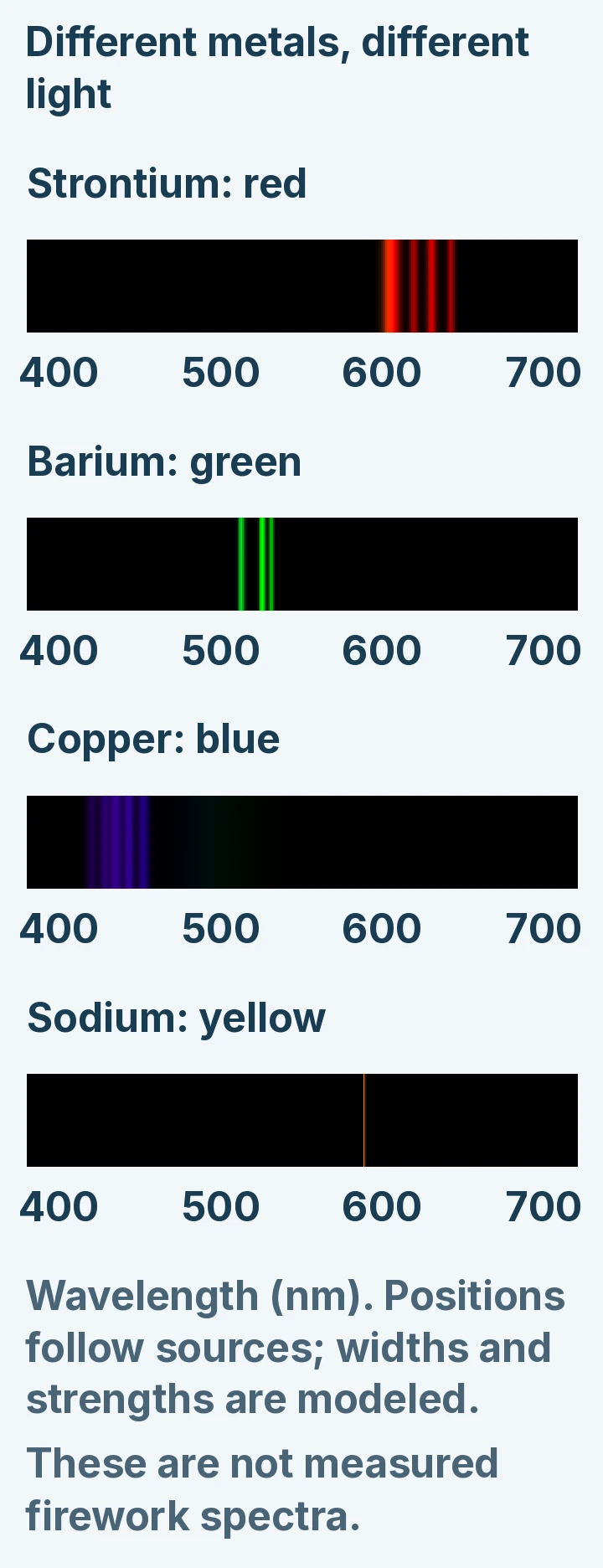
Hot particles can glow, producing the familiar charcoal-orange sparks. Another route is light emitted by atoms or molecules containing metals. Heat gives electrons energy. When they return to a lower energy state, the difference comes out as light. Different particles have different energy gaps, producing different colors. [University of Warwick; Canon]
| Metal | Typical color |
|---|---|
| Strontium | Red |
| Barium | Green |
| Copper | Blue |
| Sodium | Yellow |
A Japanese historical change
In Japan's Edo period (1603–1868), fireworks mainly varied the brightness of charcoal-orange light. Edo was Tokyo's former name. New chemicals, including strontium materials, arrived in the Meiji era beginning in 1868 and helped create brighter, richer colors. [Japan Pyrotechnics Association; Tokyo Metropolitan Government]
A prism reveals the source
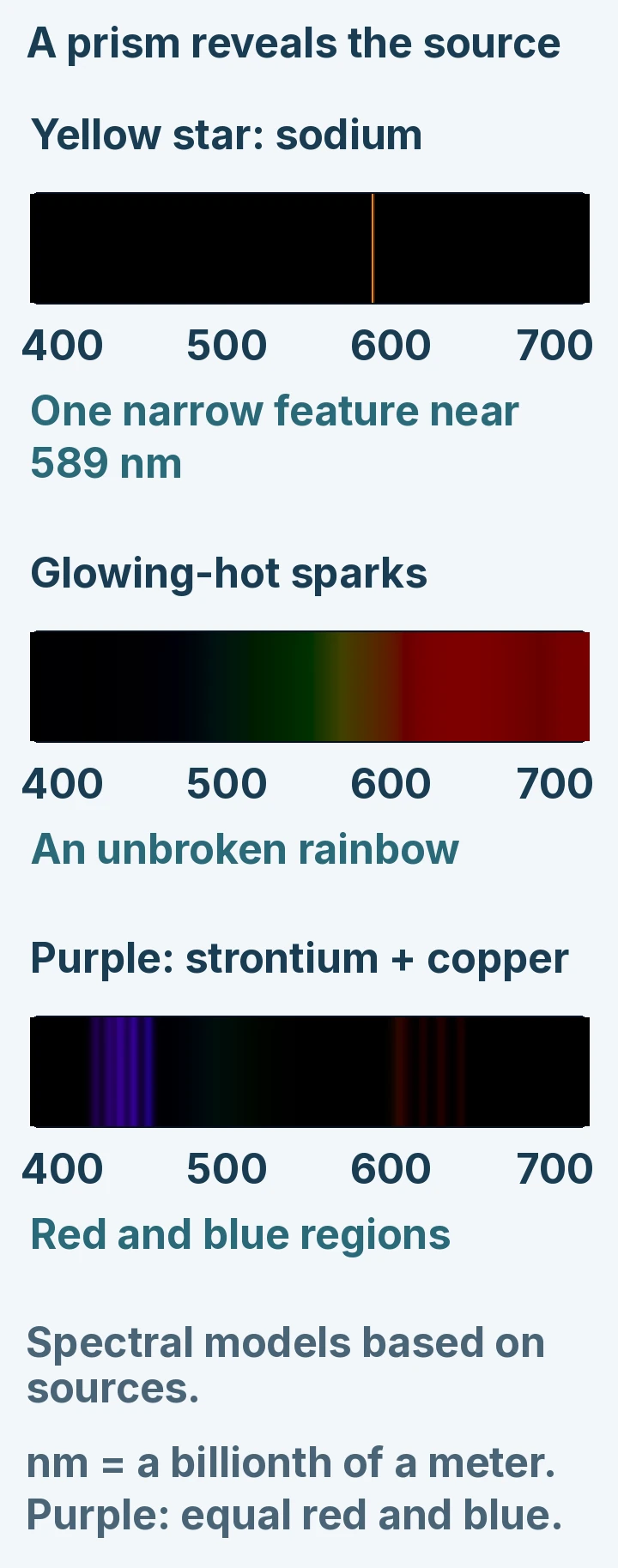
Two lights can look almost the same yellow-orange yet contain different wavelengths. We compared sodium light with modeled light from a hot glow chosen to have a similar hue.
Sodium gives a strong feature near 589 nm. A nanometer is a billionth of a meter. There are actually two strong lines very close together. A hot glow gives a continuous rainbow instead. Splitting the light reveals a difference that the overall color hides. [NIST; Yamagata Prefecture; University of Warwick]
A purple without a single rainbow match
A published purple star contains both strontium and copper materials. In this model, mixing red and blue with equal contributions to brightness produces a purple that has no single matching color in the rainbow. Other proportions can produce different results. This is a conditional result, not a claim that every purple firework lies outside the rainbow. [Sashimura and colleagues, 2007; University of Warwick; calculation C11]
Why blue is difficult
Deep blue is a challenging firework color. It can be hard to see against the night sky, and increasing brightness can wash it toward white. The light-producing chemistry adds further difficulty. Strong blue flames remain a research topic. [Paul E. Smith, 2019; Juknelevicius and colleagues, 2021]
Why a star changes color
Layers like a jawbreaker
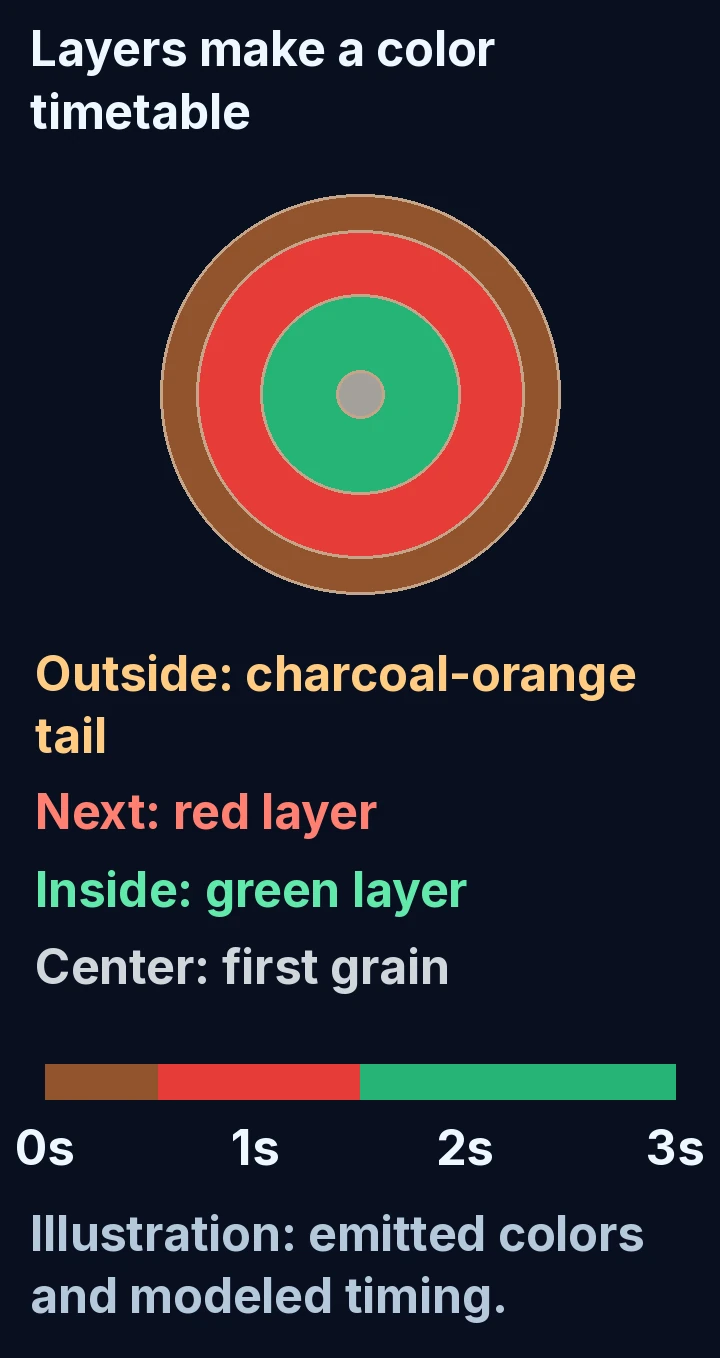
A color-changing star has layers of materials that produce different light. A jawbreaker candy is a useful comparison. Makers build up coatings around a small grain, with drying between stages. A researcher describes at least seventeen days for a round star about 0.8 inches (20 mm) across. That statement concerns that size of star, not a fixed manufacturing time for every pellet. [Japan Pyrotechnics Association; Newswitch]
Burning inward follows a timetable
The outside burns first. In our example the outer layer produces a charcoal-orange trail, the next produces red, and the next green. As the burning surface reaches each layer, the light in the sky changes too. Matching layers and sizes let many stars change together. [Canon; calculation C3]
Watch this change in the full video
Why matching stars finish together
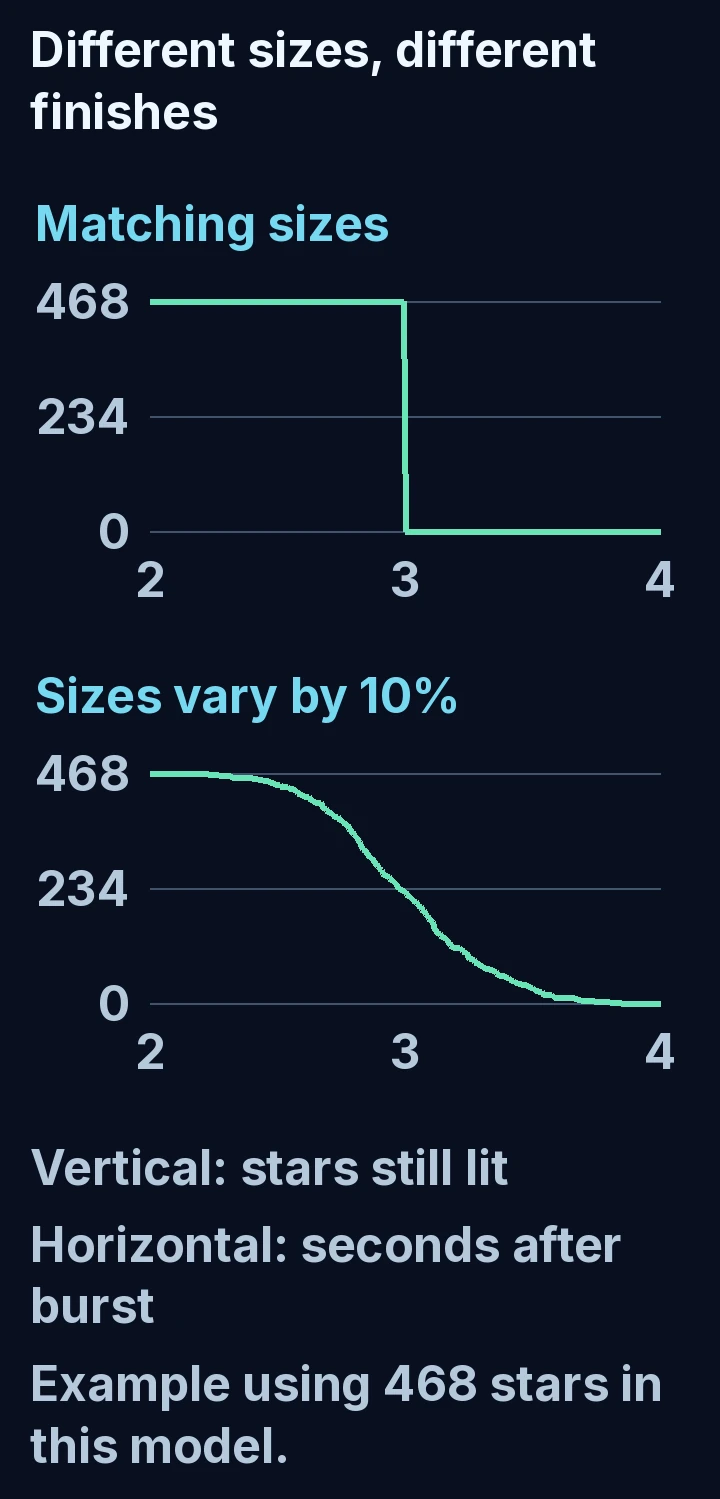
Under the same inward burning conditions, a larger star lasts longer. Our model uses about three seconds to burnout. Varying star sizes by ten percent spreads burnout times over about 0.9 seconds. It illustrates why careful size matching matters; it does not specify the exact finish of every real shell.
Frequently asked questions
Are there only four firework colors?
Red, yellow, green, and blue are basic colors that can be combined. Aluminum and magnesium can give intense white light. Pastel colors, including pink and pale blue, also appear in the association's guide. [Japan Pyrotechnics Association; Honda Kids]
Why does the boom arrive after the flash?
Light travels much faster than sound. Using about 340 m/s for sound, a burst nearly 1,000 feet (300 m) high and about 2,000 feet (600 m) horizontally away is roughly 2,200 feet (671 m) from the viewer. The boom arrives about 1.97 seconds after the flash. In the three-second burning model, stars are still lit for about another second. [Japan Meteorological Agency; calculation C12]
| Horizontal distance | Delay after flash | With a 3-second star burn |
|---|---|---|
| 980 ft (300 m) | 1.25 s | Still lit |
| 1,970 ft (600 m) | 1.97 s | Still lit |
| 3,280 ft (1 km) | 3.07 s | Around burnout |
| 4,920 ft (1.5 km) | 4.50 s | About 1.5 s after burnout |
Counting the delay and multiplying by about 340 meters gives an estimate of the distance to the sound source. That is the slant distance to the burst, not just the distance along the ground.
How high do shells open?
The association gives approximate heights of 660 feet (200 m) for No. 5, nearly 1,000 feet (300 m) for No. 10, and 1,970 feet (600 m) for No. 30 shells. Type and size matter.
Why is a heart pattern sometimes unclear?
A flat pattern looks narrow from the side. The twelve examples assume random orientation, while real makers may use arrangements to help keep a pattern upright. [All About; calculation C8]
Can I make a display shell myself?
In Japan, manufacturing fireworks is governed by the Explosives Control Act. Those directing and supervising the work must hold the required government license, according to the Japan Pyrotechnics Association. Never try to make fireworks or take them apart yourself. This explanation gives no recipes, quantities, or manufacturing instructions.
Where to read more
The Japan Pyrotechnics Association's guide is the broad introduction. Honda Kids explains the sequence and shell names; Canon explains colors. Ise City's guide introduces the four viewing points. For the numerical foundations, see the papers on flight trajectories, measured star speeds, drag, and burning time. Warwick and NIST are useful English-language starting points for the light itself.
Shorts
Sources
Where the facts and numbers in the video and on this page come from.
- Japan Pyrotechnics Association, An Introduction to Fireworks, 2026 edition (in Japanese)hanabi-jpa.jp/booklet2026/book.pdf
- Japan Pyrotechnics Association, Structure of aerial fireworks (in Japanese)hanabi-jpa.jp/uchiage/fun.html
- Honda Kids, The history and science of fireworks, interview with Dayu Ding (in Japanese)honda.co.jp/kids/explore/fireworks
- Matsunaga et al., Experiments on protective materials at fireworks sites, Industrial Explosives 54(5), 250–252, 1993 (in Japanese)jes.or.jp/mag/stem/Vol.54/documents/Vol.54,No.5,p…
- Matsunaga et al., Study on safety of aerial fireworks, Part II: trajectories of simulated shells, Industrial Explosives 50(6), 478–486, 1989 (in Japanese)jes.or.jp/mag/stem/Vol.50/documents/Vol.50,No.6,p…
- Takeo Shimizu, Design conditions of chrysanthemum fireworks (3), 18(2), 123–134, 1957 (Japanese, English summary)jes.or.jp/mag/stem/Vol.18/documents/Vol.18,No.2,p…
- Yasuhiro Sashimura et al., Burning characteristics of firework stars and compositions, Science and Technology of Energetic Materials 68(5), 141–145, 2007jes.or.jp/mag/stem/Vol.68/documents/Vol.68,No.5,p…
- Canon Science Lab for Kids, The secret of firework colors (in Japanese)global.canon/ja/technology/kids/mystery/m_04_11.html
- Newswitch / Nikkan Kogyo Shimbun, Science of fireworks, 2015 (in Japanese)newswitch.jp/p/5884
- Ise City, Ise Jingu National Fireworks Festival guide, viewing points (in Japanese)city.ise.mie.jp/_res/projects/default_project/_page_/00…
- All About, Patterned fireworks trends, July 3, 2014 (in Japanese)allabout.co.jp/gm/gc/444300
- Paul E. Smith, Red, white but rarely blue: the science of fireworks colors, The Conversation, 2019theconversation.com/red-white-but-rarely-blue-the-science-o…
- Juknelevicius et al., An Experimental Comparison of Selected Blue Flame Pyrotechnics, 2021, DOI 10.1002/prep.202000114epub.ub.uni-muenchen.de/75968/1/prep.202000114.pdf
- NIST, Handbook of Basic Atomic Spectroscopic Data, Strong Lines of Sodiumphysics.nist.gov/PhysRefData/Handbook/Tables/sodiumtable…
- Pyrotechnic colorant, Wikipedia table citing M. S. Russell, The Chemistry of Fireworks, RSC, 2009 (secondary source for modeled band positions only)en.wikipedia.org/wiki/Pyrotechnic_colorant
- Yamagata Prefecture, Identifying metals from flame colors and spectra, 2017 (in Japanese)pref.yamagata.jp/documents/5032/mondai1.pdf
- CIE, Colour-matching functions of the CIE 1931 standard colorimetric observer, 2019, CC BY-SA 4.0doi.org/10.25039/CIE.DS.xvudnb9b
- Japan Meteorological Agency, Why thunder follows lightning (in Japanese)jma.go.jp/jma/kids/kids/faq/a3_16.html
- Tokyo Tower, About Tokyo Tower (Japanese video comparison only)tokyotower.co.jp/about
- Japan Pyrotechnics Association, Frequently asked questions (Japanese law, in Japanese)hanabi-jpa.jp/uchiage/faq.html
- Pexels, Licensepexels.com/license
- University of Warwick, Physics Outreach, The colour of fireworkswarwick.ac.uk/fac/sci/physics/outreach/resources/fact…
- Tokyo Metropolitan Government, Tokyo's History, Geography, and Population, 2026english.metro.tokyo.lg.jp/w/000-101-007591
- Freesound (CC0), and Kenney (CC0). Sound effects are illustrative. Fonts: Noto Sans JP, Inter, M PLUS Rounded 1c (SIL OFL). Models, animation, and calculations: Tamelabo. Color-matching data: CIE 1931, 2019, CC BY-SA 4.0, used to calculate the illustrated light colors. CIE source: https://doi.org/10.25039/CIE.DS.xvudnb9b . Licensecreativecommons.org/licenses/by-sa/4.0