One Hundred Views of Mount Fuji by Osamu Dazai: Why Thank the Mountain? | Classics in 5 Minutes #13
The story in brief
- A writer staying at a Misaka Pass teahouse argues with Mount Fuji while people around him change what he sees.
- Asked to photograph two travelers the day before leaving, he frames them out and takes Mount Fuji alone.
- It leaves one question: how to read a final act that holds both gratitude and mischief.
Also calledOne Hundred Views of Mount Fuji summaryFugaku Hyakkei summaryOsamu Dazai Mount FujiFugaku Hyakkei endingDazai evening primrose
Video

Pressing play loads the YouTube player on this page. Watch on YouTube
Explained
In the video
A complete summary — to the ending — of One Hundred Views of Mount Fuji (Fugaku Hyakkei, 1939) by Osamu Dazai, a twentieth-century Japanese writer. If you would rather not know the ending yet, stop here. Everything below is based on the Japanese text at Aozora Bunko, a free online library of Japanese literature (the link is in Japanese). The headings are ours; the story itself has no chapter titles. The journey in the story begins in early autumn 1938; the work first appeared in the magazine Buntai in February–March 1939.
The "I" of the story is its narrator. He is close to the author, but we call him the narrator throughout. This article is our own summary and commentary in English. No translated excerpts from the story are reproduced; key moments are described in our own words.
A writer who keeps arguing with a mountain
The narrator, hoping for a fresh start, settles at Tenka Chaya, the teahouse at Misaka Pass where the writer Masuji Ibuse is already staying to work. The famous view in front of the teahouse — Mount Fuji over Lake Kawaguchi, framed by nearer ridges — strikes him as too perfect, too composed to love. But he was never simply against the mountain. A summit appearing suddenly above the clouds at Jukkoku Pass once made him laugh out loud, while the small white Fuji seen from a Tokyo apartment window is tied to painful days. From the first pages, his judgments point in several directions at once. That wobble is the story's engine: he praises the mountain, then mocks it, thanks it, and behaves badly in its name — sometimes within the same scene.
The people
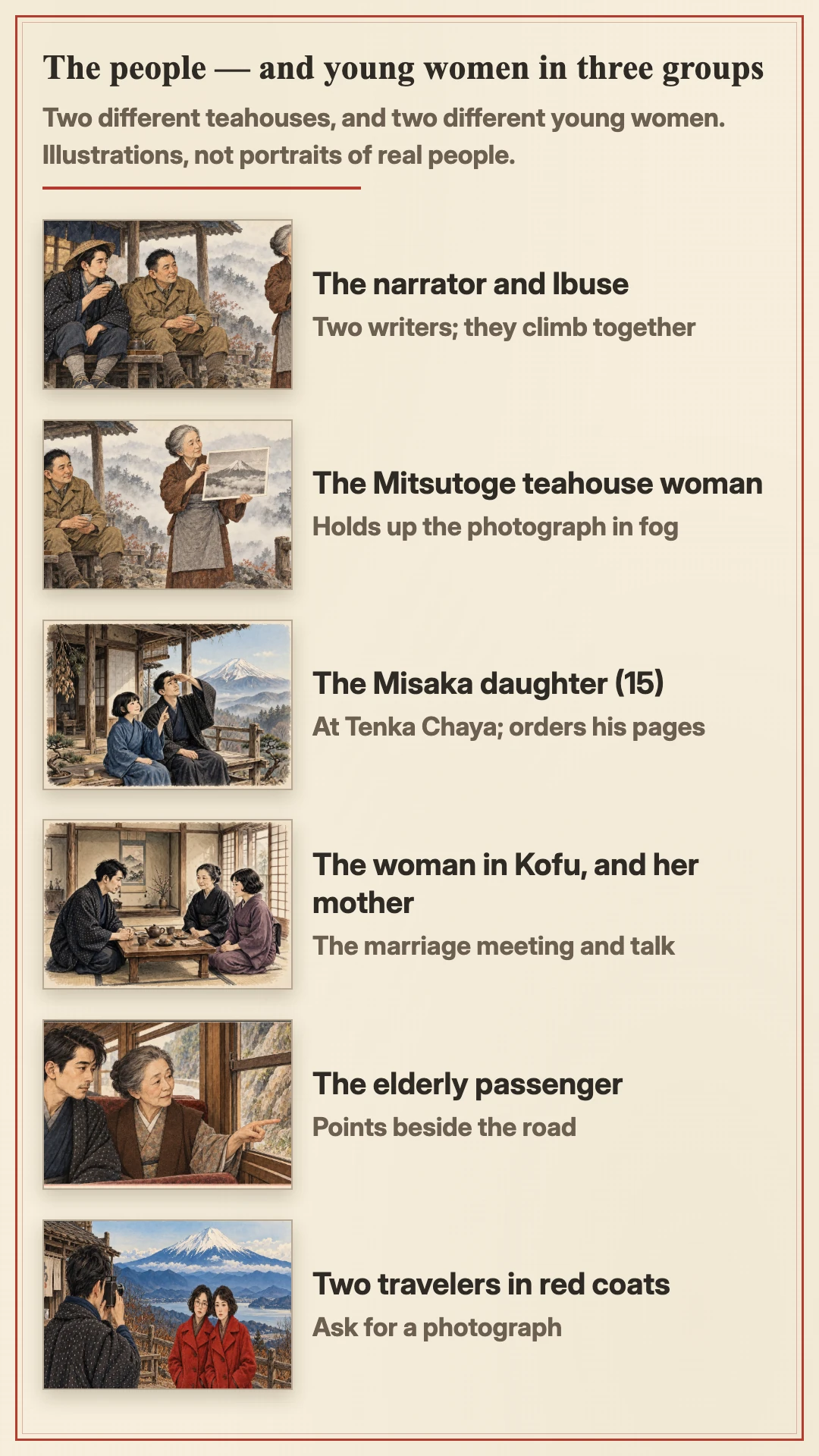
- The narrator — a writer staying at the Misaka teahouse to work, from September to mid-November.
- Masuji Ibuse — a fellow writer, already working at Tenka Chaya. He climbs Mitsutoge with the narrator and accompanies him to Kofu.
- The elderly woman at the Mitsutoge teahouse — on the foggy summit, she holds up a large photograph of Mount Fuji. A different teahouse from the one at Misaka.
- The landlady at Misaka and her fifteen-year-old daughter — the family who run Tenka Chaya. The daughter wakes him for the first snow and keeps his manuscript pages in order. Neither has a name in the text.
- The woman in Kofu, and her mother — the partner in an arranged meeting with a possible marriage partner. A different person from the teahouse daughter.
- Nitta — a young man of twenty-five who works at the post office in Yoshida, a town at the foot of Mount Fuji, and comes to visit.
- The elderly woman on the bus — sits beside the narrator on the ride back from Kawaguchi village and points at one spot beside the road.
- Two travelers in matching red overcoats — on the day before he leaves, they ask him to take their photograph.
Two photographs
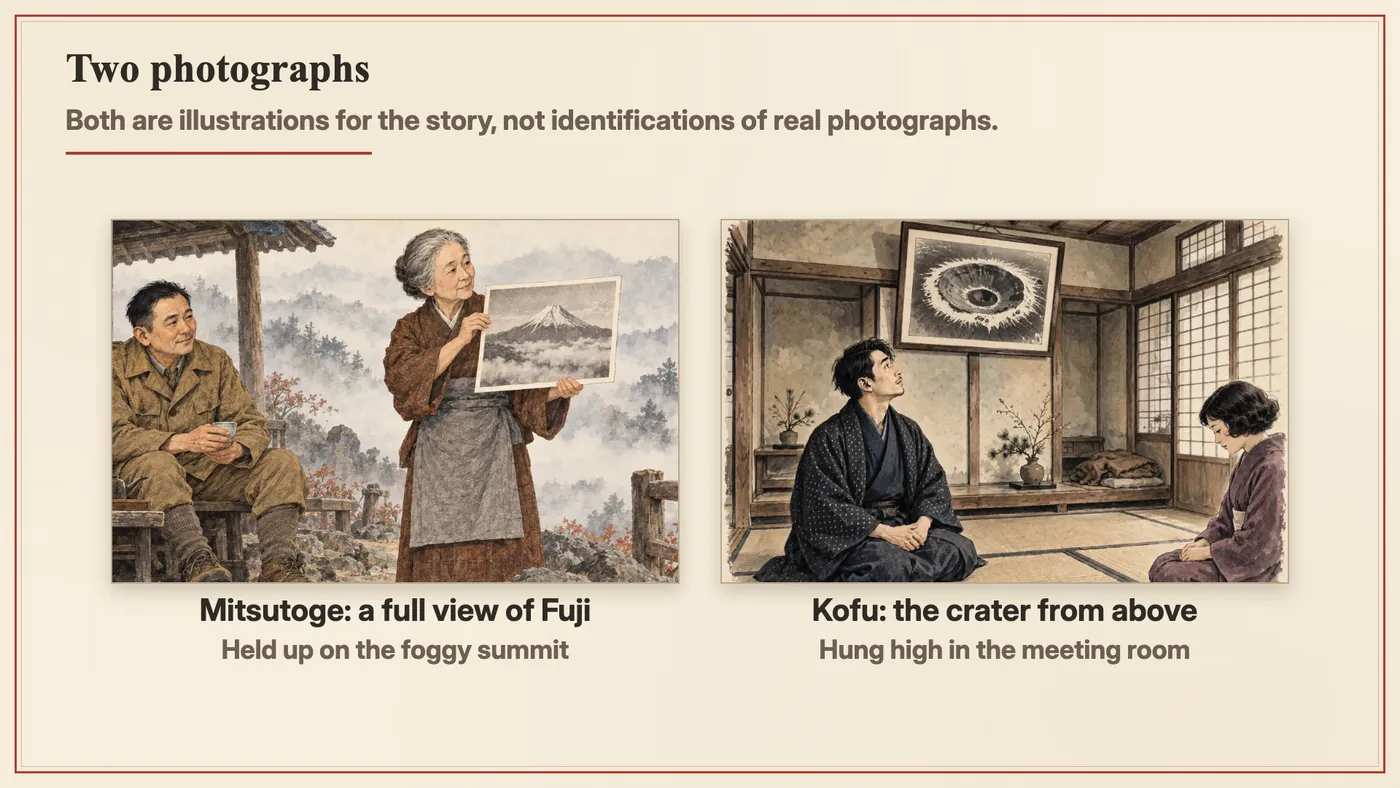
A few days after arriving, the narrator climbs Mitsutoge with Ibuse, comically dressed in a borrowed short dotera (a padded kimono coat) and a straw hat. The summit is thick with fog: no view at all. The elderly teahouse woman holds up a large photograph of Fuji instead. The two men laugh over their tea, and the narrator looks back on the moment with real fondness — a fine Fuji, seen on paper, with no regret about the fog.
Soon after, Ibuse takes him to Kofu (a city in the basin northwest of Fuji) for an arranged meeting with a possible marriage partner. High on the wall behind his seat hangs a photograph looking directly down into Fuji's summit crater. Craning up at it, then turning back, he glimpses the young woman — and decides he wants to marry her. The two photographs are different objects in different places, and both turn his eyes from the mountain toward people.
Young visitors, a blue mountain, and snow
Young men from the foot of the mountain visit the teahouse. With one group, the narrator joins in calling both Fuji and a certain monk hopelessly vulgar, and later finds the memory embarrassing. With Nitta, the gentle postal worker from Yoshida, the silent mountain suddenly strikes him as something great. Company does not reliably improve his view; it changes it, in both directions.
On a moonlit night in Yoshida he walks beneath a blue, dreamlike Fuji, rather pleased with himself — then has to go back for the wallet he dropped. One morning the teahouse daughter, fifteen, wakes him to see the first snow on the summit. He is delighted, and at once lectures her that the mountain is nothing without its snow. Around this time he collects evening primrose seeds and sows them behind the teahouse. Whether they ever flowered, the text does not say.
The evening primrose
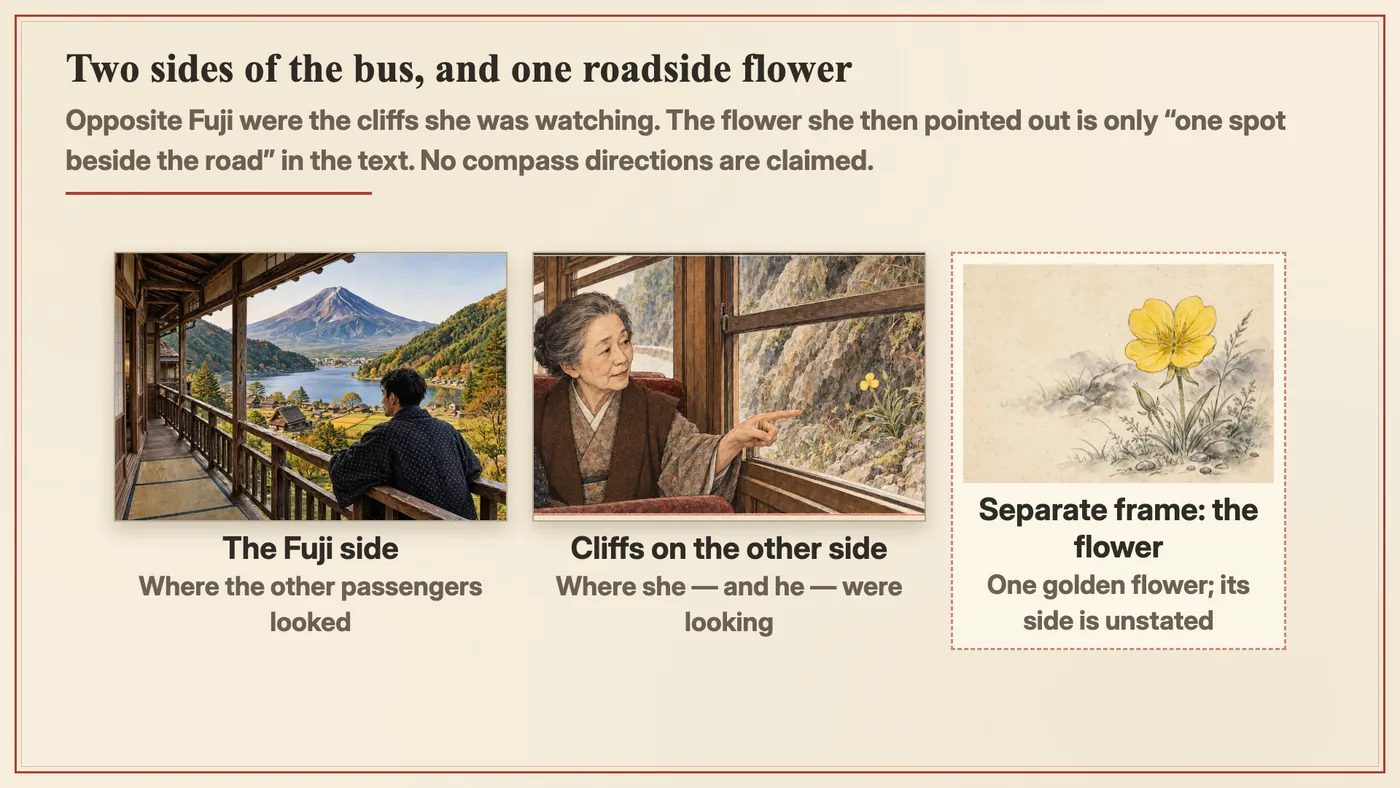
Why evening primroses? The narration turns back to a bus ride. Returning from collecting mail in Kawaguchi village (the lakeside village, not the lake itself, and not Nitta's post office in Yoshida), he notices that while every other passenger faces Mount Fuji, the elderly woman beside him stares at the cliffs on the opposite side. In his own mind, he decides she must feel as he does.
Then she speaks — a small remark — and points at one spot beside the road. The bus is already past it, but a single golden-yellow flower stays in his eyes, standing straight and brave. From that moment, in his mind, the great mountain and the tiny roadside flower belong together.
Two cautions for readers. First, what lay opposite Fuji was the cliff she had been watching; the flower she pointed out afterward is placed by the text only "beside the road." Its side of the bus, and whether it grew at a cliff's edge, are not stated — in our figure the flower sits in a separate frame for exactly that reason. Second, whatever sorrow or life story the narrator imagines for her is his projection, not something the text confirms. What she actually gives him is not understanding, but a flower.
What looking cannot do
Past mid-October his work stalls and he grows lonely. One day he watches from upstairs as a group of women — women working in the sex trade, as the story's word means — choose picture postcards below. It pains him; he finds himself entrusting their happiness to Mount Fuji. But there is nothing he can actually do, and he leaves the place with a child and a dog in tow. The text does not say the women were helped, and we should not add circumstances or feelings for them. The scene marks the limit of his way of relating to the world: by looking, feeling, and walking away.
A difficult talk in Kofu, and life at the teahouse
As the marriage talks advance, he learns that no money will come from his family home. He goes to Kofu and tells the young woman and her mother honestly. Her mother answers that what matters is love, and devotion to his work. (No family support is not the same as family opposition to the marriage; the text keeps those apart, and so should we.) Walking back, the young woman asks whether snow has fallen on Fuji yet — a considerate question, her own words make clear, for the man living up at the pass. The mountain rests between them, giving two near-strangers something gentle to talk about.
At Misaka, the teahouse daughter tells him she looks forward to putting his manuscript pages in order; he receives it as pure encouragement. On another day he realizes she seems afraid of him, and from then on he avoids leaving his room when they are alone in the house. Her feelings are known only as he perceives them; the text gives no cause, and no romance. A passing bride's yawn draws a catty guess from the narrator and the daughter together — a guess, not a fact about the bride. With a senior's help, holding the wedding becomes possible (the ceremony itself is not shown), and the landlady, worried about the cold, brings in a kotatsu — a heated table with a quilt.
The ending: the last photograph, and one more morning
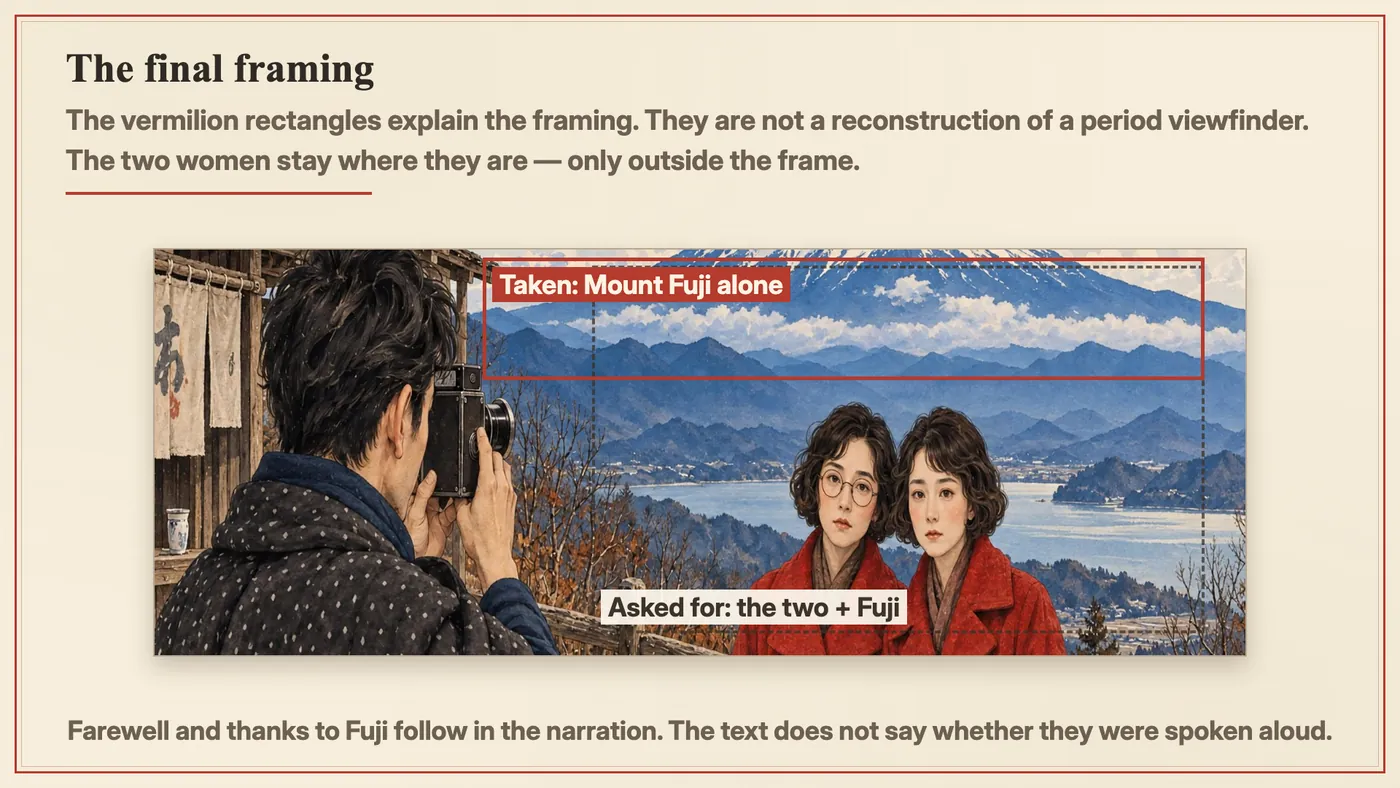
On the day before he leaves the mountain, wrapped in two padded coats, he is asked by two travelers in matching red overcoats to take their photograph. They pose close together. His hands tremble; he holds back a laugh. And he deliberately moves them out of the lens and fills the frame with Mount Fuji alone. In the narration around the click, he bids the mountain farewell, with thanks. Whether those words were spoken aloud or only written, the text does not say, and our video does not decide it either. The two women thank him in unison. They will be surprised when the film comes back, he imagines — the story never shows that moment.
Nor does it end at the shutter. The next day he comes down to Kofu, stays the night, and in the morning leans on the inn's railing to find Fuji with its lower two-thirds hidden behind nearer hills, only the white top showing, like a ground cherry. That small, partial mountain is the story's last view.
Questions to read with
- Do the mountain's changes and his judgments move together? Fog earns affection; snow earns a lecture. Weather and verdict rarely line up neatly.
- How much does he actually know of other people's hearts? The bus passenger's imagined sorrow and the teahouse daughter's fear are both his readings. The text lets those people keep most of themselves.
- How should we read the final thanks beside the final trick? Our episode suggests hearing the teahouse and Kofu kindnesses inside the thanks. But the text gives no single reason, and the same gesture also cheats two strangers of their portrait. The comedy and the gratitude refuse to separate.
Frequently asked questions
Does the narrator hate Mount Fuji at the start?
No. He dislikes the composed view from Misaka, but the opening also recalls a Fuji that made him laugh at Jukkoku Pass and one tied to painful days in Tokyo. His views are several from the start.
Does he marry the teahouse daughter?
No. His marriage partner is the woman he meets in Kofu. The fifteen-year-old at the Misaka teahouse is a different person, and the story goes as far as the wedding becoming possible, not the ceremony.
Is the evening primrose white?
In this text it is golden-yellow. The story does not settle the botanical species; read the color as written.
What is in the last photograph?
Mount Fuji alone. He frames the two travelers out. Their surprise at development is only his prediction; it is never shown.
Does the story end with the photograph?
No. He descends to Kofu, stays a night, and sees a partly hidden Fuji the next morning. That is the ending.
Does "One Hundred Views" mean one hundred photographs?
The text does not present a hundred photographs, and the title's origin cannot be settled from the text alone.
Sources
Where the facts and numbers in the video and on this page come from.
- Osamu Dazai, Fugaku Hyakkei, at Aozora Bunko (— Aozora Bunko is a free online library of Japanese literature. The text uses older kana spelling; our Japanese article includes a short guide to the forms that appear in this story (for example, older spellings read as niau, "to suit," and sayōnara, "farewell"))aozora.gr.jp/cards/000035/files/270_14914.html
- Aozora Bunko No. 270aozora.gr.jp/cards/000035/card270.html
- publisher's page (. Our English summary above is the free English companion for this episode)ndbooks.com/book/early-light
Voice, music, art
- Voice: Kokoro (synthetic speech)
- Music (OpenTracks): “茶屋にて” by MATSU / “縁側” by siroimu / “百花繚乱” / “藁の記憶”
- Fonts: Shippori Mincho, IBM Plex Sans JP, M PLUS Rounded 1c (SIL Open Font License 1.1)