The Nighthawk Star by Kenji Miyazawa: What Was Yodaka Trying to Escape? | Classics in 5 Minutes #17
The story in brief
- Threatened by a hawk and distressed by the insects he kills, Yodaka sets out for the farthest sky.
- After his brother’s pleas and the stars’ refusals, his final ascent ends in a quiet blue light.
- The ending leaves readers to consider refuge, beauty, and the sadness that remains.
Also calledThe Nighthawk Star summaryYodaka endingKenji Miyazawa nighthawk
Video

Pressing play loads the YouTube player on this page. Watch on YouTube
Explained
In the video
- 0:00Change your name, or be killed
- 0:29Scorned, but strong in flight
- 0:51The name the hawk demands
- 1:35The struggling insect
- 2:19A brother asks him to stay
- 2:49A plea to the sun
- 3:17No refuge among the stars
- 3:50One last ascent
- 4:20A quiet blue light
- 4:42Returning to the insect scene
- 5:11Commentary and the original
Spoilers follow, including the ending. This is our own summary of Kenji Miyazawa’s Japanese original. The original has no numbered chapters or chapter titles; the scene headings below are reading aids.
The story in 30 seconds
Despised by other birds, Yodaka, the story’s nighthawk, faces a threat from a hawk: change his name or be killed. While catching insects, he becomes painfully aware that his own life also depends on taking lives. He says goodbye to his kingfisher brother and asks the sun, then the stars, to take him away. The stars offer no refuge. After one last ascent, his exhausted body becomes a quiet blue light beside Cassiopeia. Miyazawa’s tale follows both the cruelty Yodaka suffers and the suffering he recognizes in others. Its ending leaves readers with an image to consider, rather than a single stated lesson.
The birds and the name at stake
Yodaka is the nighthawk of the title. He has a mottled face, a flat beak, a very wide mouth, and weak legs. Other birds despise his appearance. Yet his wings are exceptionally strong. His flight and piercing cry resemble those of a hawk.
That resemblance explains his name. Taka means “hawk” in Japanese. Although Yodaka is not related to the hawk, his name contains the same sound. The hawk resents sharing it and treats Yodaka’s name as something he has no right to keep.
In the story, the kingfisher and the hummingbird are Yodaka’s younger brothers. The kingfisher eats fish; the hummingbird feeds on nectar; Yodaka catches insects. These family relationships belong to the tale, rather than to a scientific classification of birds.
The kingfisher tries to stop Yodaka from leaving. The hummingbird lives far away and is not present at their farewell. This matters: the story does not portray every bird as equally hostile to Yodaka.
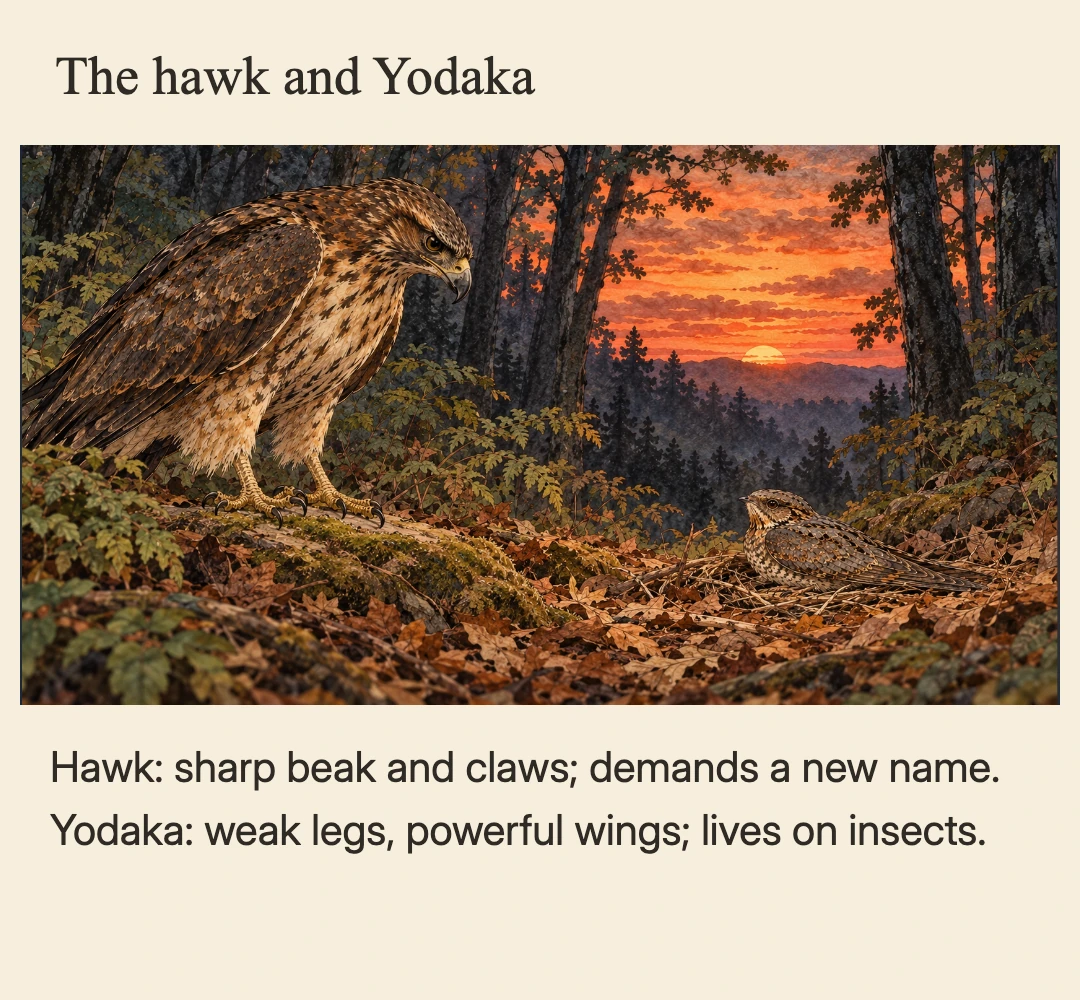
The gray-brown and rust-colored plumage in our illustrations is a production choice based on the story’s description of a mottled bird. The pictures are literary illustrations, not wildlife documentation.
The plot, scene by scene
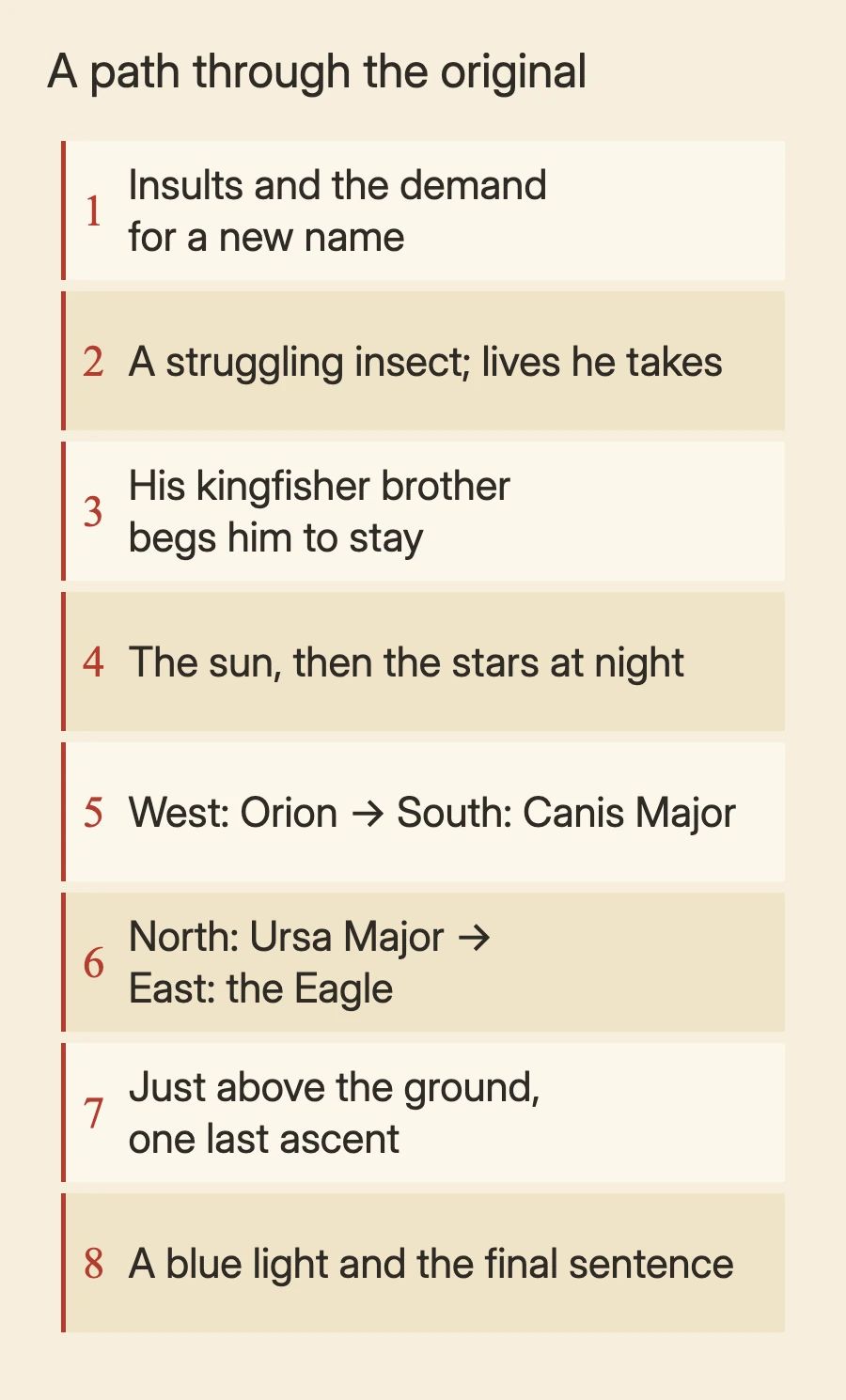
Insults and the demand for a new name
A skylark turns away from Yodaka. Smaller birds mock his mouth. Without sharp claws or a sharp beak, he frightens none of them. His powerful flight is a different matter: the narrator introduces that strength before the hawk arrives.
One evening, the hawk comes to Yodaka’s nest. He orders him to take the name Ichizō. This is more than a private change of name. Yodaka must wear a sign bearing the new name, visit the other birds, bow, and announce the change. If he has not obeyed by the morning after next, the hawk threatens to seize and kill him.
The humiliation lies in having his own name taken away and being forced to display his submission publicly. There is no need to assume that Ichizō is an embarrassing or inferior name. That judgment is not supplied by the original.
Yodaka says he cannot comply. After the hawk leaves, he remembers rescuing a baby white-eye that had fallen from its nest. When he returned it, the parent pulled the baby away from him and laughed at him. Even an act of kindness has left him with a memory of rejection.
The text never shows Yodaka putting on the sign or carrying out the visits. An order is not the same as an action performed.
The insect and the painful recognition
As darkness gathers that same evening, Yodaka leaves his nest. He stretches his wings and catches insects in his open mouth. A beetle enters his throat and struggles.
The original describes two successive beetle encounters. First he feels a shudder; then another struggle brings a shock to his chest, and he begins to cry. The physical experience comes before the thought. His distress is not introduced as an abstract lesson about food.
He thinks of the many insects he kills each night, and of the hawk who now threatens to kill him. The life he fears losing is itself sustained by taking lives. He considers not eating, but that does not remove the hawk’s threat. He resolves to go beyond the farthest sky.
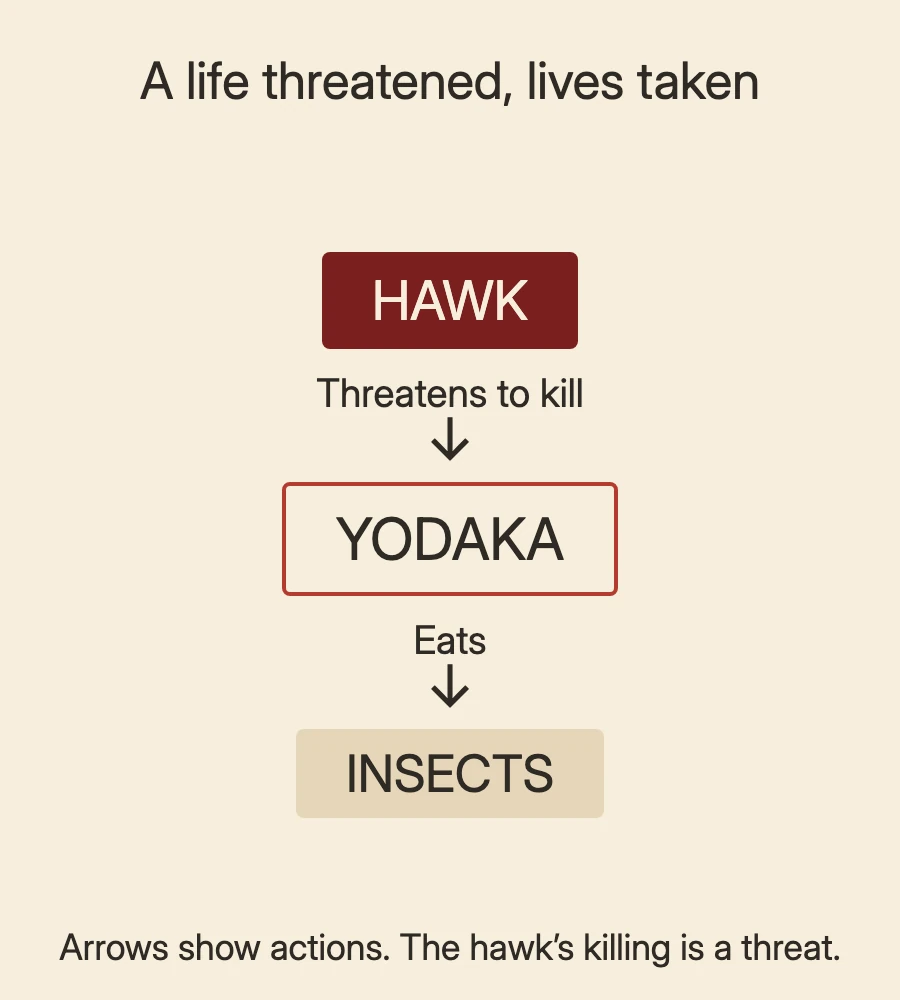
The hawk’s arrow represents a threat. It does not show the hawk actually killing or eating Yodaka.
A brother who asks him to stay
With mountain fires glowing red in the distance, Yodaka visits the kingfisher. His brother asks him not to go: with the hummingbird already far away, he would be left alone.
Yodaka asks him not to catch fish needlessly, except when he truly has to. He does not demand that the kingfisher stop eating fish altogether. The request carries the pain of the insect scene into the farewell.
Despite the kingfisher’s pleas, Yodaka leaves a message for the distant hummingbird and goes home in tears. To summarize this as the departure of a bird “loved by nobody” would erase his brother’s concern. The harder question is why Yodaka leaves even when someone wants him to stay.
From the sun to the stars
The short summer night ends. Yodaka tidies his nest, arranges his feathers, and flies toward the sun. He begs to be taken in, even if he burns to death. This is the desperate wish of the character, not an instruction to the reader.
The sun acknowledges his suffering and tells him to ask the stars that night. It does not transform him into a star. Yodaka falls onto the grass and enters a dreamlike state. A sensation of being seized by the hawk occurs within that passage; it should not be turned into a confirmed attack in the waking story.
A drop of dew from a young grass leaf wakes him. It is night. He takes to the sky and makes his requests in this order:
- Orion, in the west, continues singing and ignores him.
- Canis Major, in the south, flickers blue, purple, and yellow and tells him that a bird’s wings cannot span the immense distance.
- Ursa Major, in the north, quietly tells him to cool his head.
- The Eagle, Aquila, in the east, says that becoming a star requires suitable rank and money.
The responses are not interchangeable. One refuses to notice him; another invokes distance; another dismisses his thinking; the last sets social and financial conditions. The sky offers no place where he is welcomed.
The directions belong to the literary scene. Our pictures do not claim to reproduce the constellations as seen from a specified place and date, and the enormous time invoked by Canis Major is a rebuff rather than a travel calculation.
The last ascent
Yodaka closes his wings and falls. Just before his weak feet touch the ground, he shoots upward. He does not strike the earth and then take off again.
His piercing cry resembles a hawk’s. Sleeping birds wake and tremble. As he climbs, the mountain fires grow tiny, but the stars remain the same size. The earth recedes without the stars seeming any closer.
Cold and thin air exhaust him. His wings become numb; he can no longer tell whether he is rising, falling, or upside down. The narrator speaks of his end, yet also describes his peaceful state of mind and a small smile.
The ending: a quiet blue light
This section discusses the ending. After a while, Yodaka opens his eyes. His body has become a beautiful blue light, burning quietly. Cassiopeia is next to him, and the pale Milky Way lies behind him.
Even now, it is still burning. Our translation of the final sentence of The Nighthawk Star, from the Japanese text at Aozora Bunko.
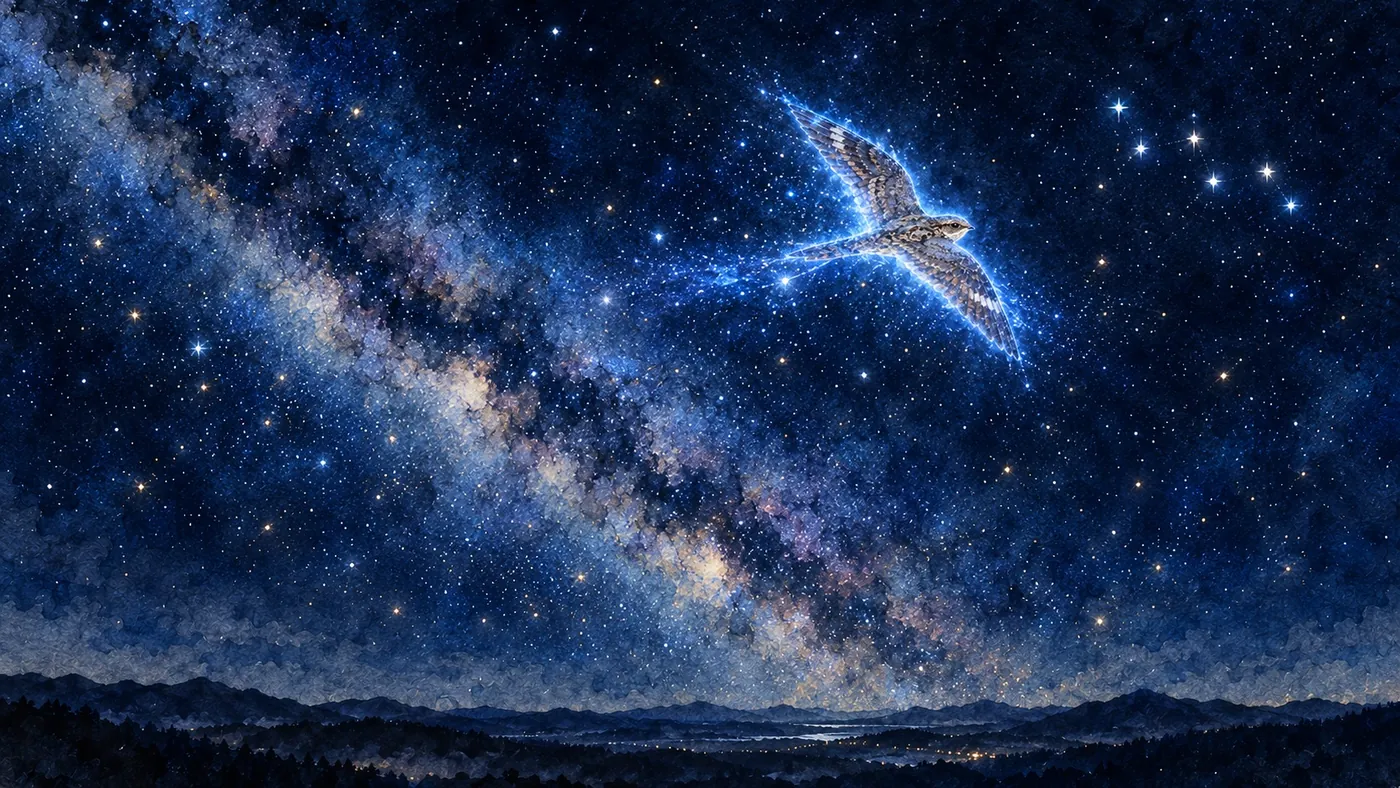
The tale does not add an apology from the hawk, a change of heart among the other birds, or a reunion with the kingfisher. Its earthly conflicts are not all settled. Yet the final image is beautiful and quiet, and Yodaka’s last state of mind is peaceful. Both sides of that ending deserve room.
Three questions for a second reading
How does the fear of being killed connect with the lives he takes?
The hawk’s threat places Yodaka on the receiving end of cruelty. The insect scene makes him recognize himself as a taker of lives as well. Follow the order from bodily discomfort to tears to thought. What changes when the story asks us to hold both positions together?
Why leave a brother who wants him to stay?
The kingfisher does not reject Yodaka. Nevertheless, Yodaka asks him to avoid needless killing and leaves. We might read this as suffering that affection alone cannot resolve. That is a question prompted by the actions in the text, not a claim to know Miyazawa’s private intention.
What remains beside the peaceful light?
The blue light may look like refuge. But the cold, the failing wings, and the brother left behind remain part of the story. Instead of choosing a single moral immediately, ask which words support a hopeful reading and which leave sorrow behind.
The character’s wish to burn does not have to become a recommendation for readers. This article does not present self-destruction as a solution to suffering in real life.
Frequently asked questions
Why does the hawk demand a new name?
He dislikes sharing the sound taka, meaning hawk, with Yodaka. The opening explains the resemblance in flight and voice. During the visit, the hawk asserts his superiority and demands a public announcement of the new name, complete with a sign and bows.
Does Yodaka actually become Ichizō?
The text does not show him accepting the new name or wearing the sign. The hawk demands these actions, but Yodaka says he cannot do them. Keep the demand separate from what the story shows him doing.
Why does he cry after catching an insect?
After the beetle struggles in his throat, he thinks about the insects he kills every night and the hawk who threatens to kill him. The pain is in that connection, not simply in disliking the taste of an insect.
Does the kingfisher dislike his brother?
In their farewell scene, the kingfisher begs Yodaka not to leave and asks him to wait. His concern is different from the other birds’ contempt. The story should not be flattened into universal rejection.
What happens to Yodaka at the end?
After the account of his final exhaustion, his body becomes a blue light, and the narrator says that it continues burning as a star. He does not return safely to earth. Whether that image means happiness or rescue is a question of interpretation rather than an extra event in the plot.
Read the Japanese original
Read the complete Japanese text at Aozora Bunko, a free online library offering Japanese public-domain literature. The book card provides another route to the text.
For a second reading, search the original for 「一疋の甲虫が」, the beetle passage. Then try 「それからしばらくたって」 near the ending and read through the final sentence. Those passages let you compare Yodaka’s painful recognition with the image that closes the tale.
The World of Kenji Miyazawa has an English introduction. It includes excerpts from a published translation; it is not a free complete English edition. Our plot summary above was written independently from the Japanese original. Short translated quotations here are marked “Our translation.”
Source: Kenji Miyazawa, Yodaka no Hoshi, Aozora Bunko (in Japanese). Base edition: Shinpen Ginga Tetsudō no Yoru, Shinchō Bunko, Shinchōsha. Transcription: 佐々木美香; proofreading: 野口英司. Bird-shape reference: Jason Thompson, Caprimulgus jotaka.jpg, CC BY 2.0 (the photograph itself is not reproduced).
Sources
Where the facts and numbers in the video and on this page come from.
- Kenji Miyazawa’s Japanese originalaozora.gr.jp/cards/000081/files/473_42318.html
- book cardaozora.gr.jp/cards/000081/card473.html
- The World of Kenji Miyazawa has an English introductionkenji-world.net/english/works/texts/yodaka.html
- Caprimulgus jotaka.jpgcommons.wikimedia.org/wiki/File:Caprimulgus_jotaka.jpg
- CC BY 2.0creativecommons.org/licenses/by/2.0
Voice, music, art
- Voice: Kokoro (bm_fable, Apache-2.0). Japanese version: Irodori-TTS (selected narrator, MIT).
- Music (OpenTracks): “茶屋にて” by MATSU; “縁側” by siroimu; “百花繚乱” (artist not listed); “藁の記憶” (artist not listed). Audio supplied by the operator.
- Fonts: Shippori Mincho, IBM Plex Sans JP, Source Serif 4, Inter, M PLUS Rounded 1c (SIL Open Font License).
- Illustrations: Tamelabo, generated with ChatGPT. Environmental motion and diagrams: Tamelabo, created with code.